Air Conduction vs Bone Conduction Headphones
Open-ear air conduction aims airborne sound into an unsealed ear canal, while bone conduction vibrates the cheekbone or temple to reach the cochlea.
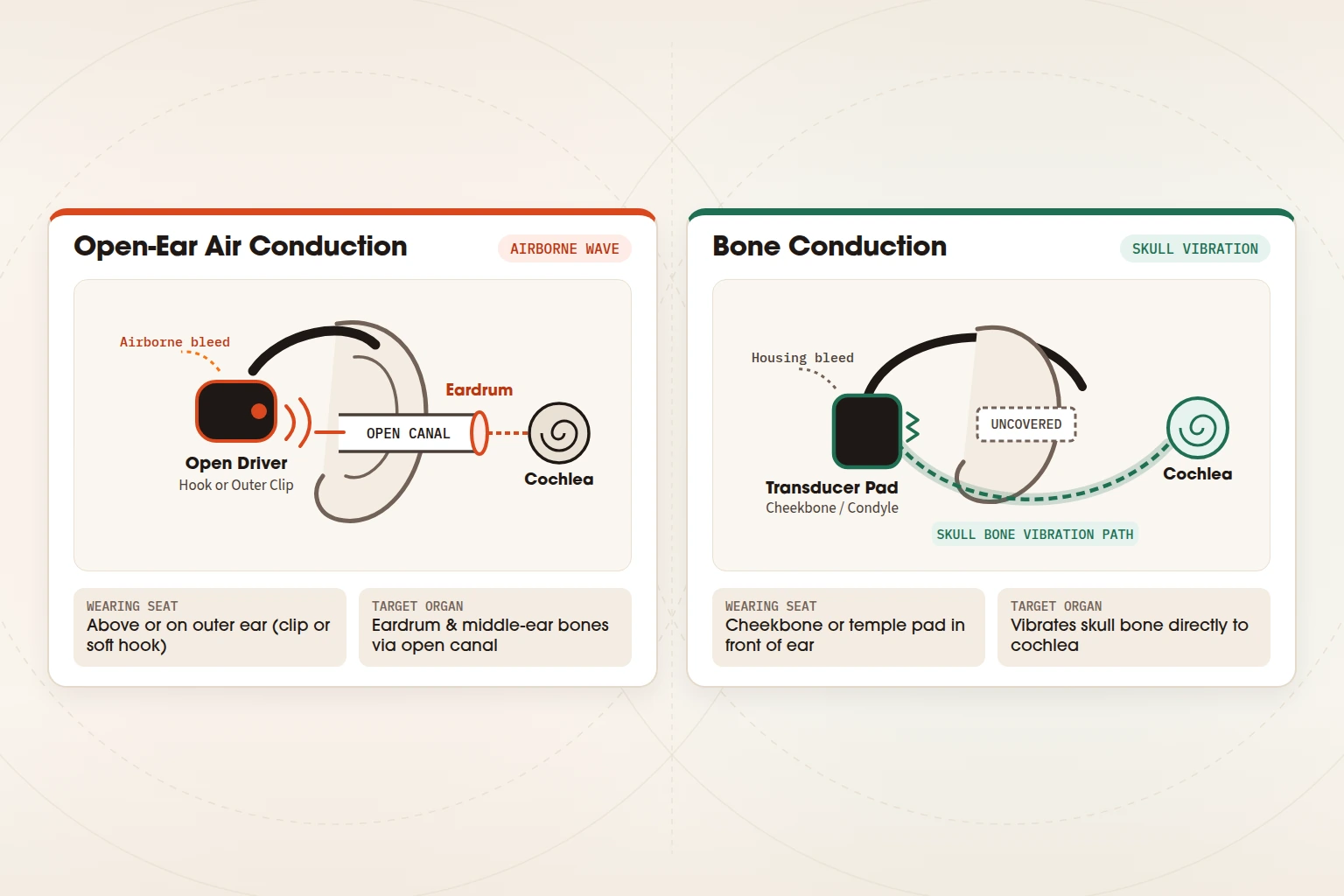
Open-ear air-conduction headphones sit slightly above or in front of the ears and direct airborne sound waves into an unsealed ear canal, where those waves vibrate the eardrum and pass through the middle-ear bones to the cochlea. Bone-conduction headsets place a transducer against the cheekbones or temples so vibrations travel through the skull bones to the inner ear while leaving the ear canal uncovered. Everyday hearing already combines skull vibration with airborne sound entering the canal, while intentional bone-conduction headphones drive sound through bone on purpose, and hybrid models such as the Shokz OpenRun Pro 2 covered on our portable audio and wearables hub combine bone-conduction and air-conduction drivers.
Bass, sound leakage, and comfort work as three separate tradeoffs across the two open-listening routes. On low frequencies, Wikipedia’s bone conduction overview notes that bones are generally more effective at transmitting lower-frequency sounds than higher-frequency sounds. In consumer headphone comparisons, Shokz writes that audiophiles call air-conduction headphones superior for delivering a broader range of frequencies through the ear’s natural acoustics, with bone-conduction bass often being particularly thin. Both air-conduction and bone-conduction headphones can leak audio to people nearby, though Shokz describes bone-conduction leakage as not nearly as loud as open-back air-conduction leakage. For wearing comfort, open-ear air-conduction hooks sit above the ear canals without pressure on the canal, whereas bone-conduction pads press against the temples or cheekbones and create vibrations that some listeners find unsettling.
Leaving the ear canal open does not eliminate fit checks with eyewear and helmets or safe-volume limits. Headband sizing, condyle placement, water-resistance ratings, and glasses-arm order belong in our bone conduction headphones fit and sound leakage guide, while ear-tip fit, speaking comfort, and battery settings belong in our ANC earbuds seal, occlusion, and battery guide.
How Do Open-Ear Air-Conduction Earbuds Work Without a Seal?
Open-ear air-conduction earbuds project airborne sound waves toward the eardrum from just outside the ear canal instead of plugging the canal opening. As the National Institute on Deafness and Other Communication Disorders (NIDCD) explains, airborne hearing converts sound waves in the air into electrical signals that the auditory nerve carries to the brain. Sound waves bounce off the pinna and concha of the outer ear, enter the ear canal, and vibrate the eardrum, which sends those vibrations to three tiny bones in the middle ear called the malleus, incus, and stapes. Those middle-ear bones amplify the vibrations and pass them into the fluid-filled cochlea in the inner ear, where hair cells near the wide end detect higher-pitched sounds and hair cells closer to the center detect lower-pitched sounds.
An open outer ear leaves the pinna and external ear canal in the airborne path, where they form direction-selective filters. According to Wikipedia’s sound localization article, the pinna and external ear canal form direction-selective filters whose active resonances change with input direction so the auditory system can judge where external sounds originate. Soundcore describes open-ear air-conduction headphones as sitting slightly above or in front of the ears and directing sound waves toward the eardrums through open drivers without sealing the ear canal. On newer air-conduction models such as OpenFit 2+, Shokz states that optimized acoustic ports and directional sound technology help reduce sound leakage compared with traditional open-ear speakers.
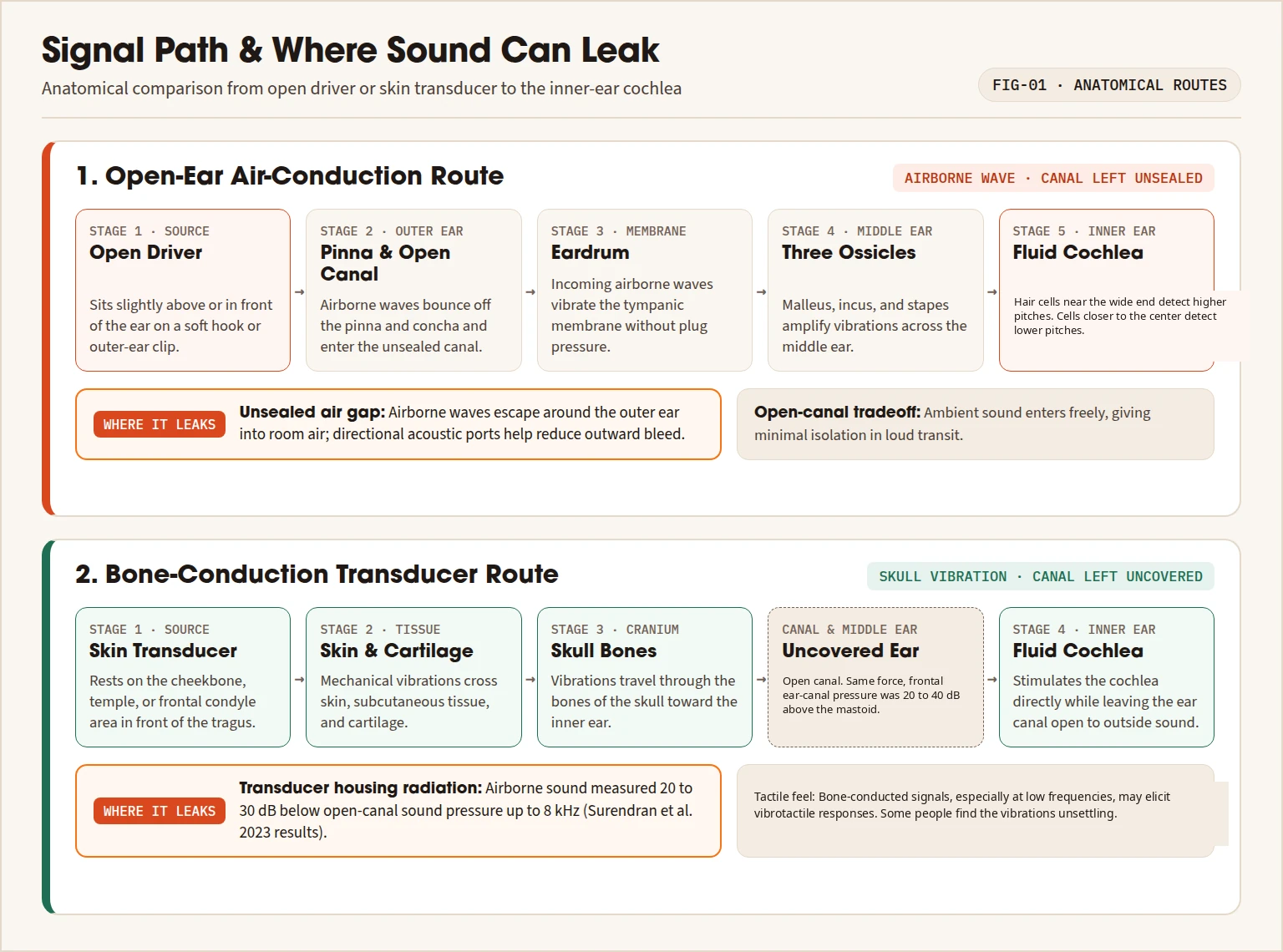
Unsealed geometry changes noise isolation compared with canal-inserted tips. In Wikipedia’s headphones overview, earphones fitted in the outer ear facing the canal without being inserted into it provide hardly any acoustic isolation, allowing ambient noise to seep in so listeners may compensate by turning up the volume. By contrast, in-ear headphones are inserted into the ear canal itself and block much environmental noise.
How Does Sound Quality Compare Between Air and Bone Conduction?
Comparing sound quality between air conduction and bone conduction requires separating skull-bone acoustics from small wearable transducers. In Wikipedia’s bone conduction entry, bones are generally more effective at transmitting lower-frequency sounds compared to higher-frequency sounds, and because the skull conducts lower frequencies better than air, people perceive their own voices to be lower and fuller than others hear on a recording. In consumer headset listening, Shokz states that air-conduction headphones use the ear’s natural acoustics to deliver a broader range of frequencies and clear sound output, whereas subtle nuances are easier to miss on bone-conduction headphones and the bass is often particularly thin. Wikipedia’s headphones article likewise notes that magnetostriction headphones (sometimes sold under the label Bonephones) vibrate against the side of the head and are limited in fidelity compared to conventional headphones that rely on the normal workings of the ear.
Transducer position and contact area change bone-conduction sensitivity and clarity in the studies below. In Surendran, Prodanovic, and Stenfelt’s Trends in Hearing study, the authors note that most communication headsets claiming bone conduction use a headband with two transducers placed on the skin in front of the ear-canal opening rather than behind the ear, often superior to the area between the condyle of the lower jaw and the tragus over skin, subcutaneous tissue, cartilage, and bone. In their head model, mastoid stimulation used a circular plate of 175 mm 2, and the frontal position used a rectangular area of 195 mm 2. Soft-tissue mechanical parameters under that model mastoid plate were adjusted for a static force of 5.4 N. In their experimental setup, the mastoid headset used an interface area of approximately 175 mm 2 with a static force of 2 to 3 N, and the frontal Aftershokz Aeropex headset provided a static force of around 2 N.
Moving the bone transducer forward near the canal opening changed both sensitivity and ear-canal sound pressure in that head-model and probe-microphone study. Stimulation close to the ear-canal opening improved bone-conduction sensitivity by around 20 dB and by up to 40 dB at some frequencies, while transcranial transmission ranged typically between -40 and -25 dB. With the same dynamic stimulation force, frontal application produced ear-canal sound pressure 20 to 40 dB higher than mastoid application. In the study’s results, radiated airborne sound pressure from the Aftershokz transducer measured at the artificial mastoid was 20 to 30 dB below the open ear-canal sound pressure at frequencies up to 8 kHz. In the discussion, the authors note that airborne sound from the Aftershokz transducer was 10 to 30 dB below ear-canal sound pressure at frequencies up to 8 kHz and around 5 dB below at frequencies of 10 kHz and above, supporting their reading that the ear-canal sound was not mainly airborne radiation from the transducer.
Pad position and canal load also shift clarity across bone and headphone listening tests. In Wang and colleagues’ Trends in Hearing study, eleven normal-hearing participants were evaluated across three stimulation positions (temple, mastoid, and condyle) and four types of headphone ear-canal occlusion: condyle stimulation gave the best performance while temple stimulation showed the worst performance for hearing thresholds, speech intelligibility, and music sound quality. In that same study, in-ear headphones gave the highest occlusion effect while fully open headphones gave the least, and bone-conducted speech intelligibility improved with greater occlusion, especially at the temple position. Separately, Bonnet, Nélisse, and Voix’s loudness balance study in the Journal of the Acoustical Society of America distinguished listening via an open ear with a loudspeaker, a cushioned ear with headphones, and an occluded ear, finding in 18 normal-hearing listeners that occluded-ear and cushioned-ear in-ear sound pressure levels agreed within 1 dB at equal loudness.
Where Do Open-Ear Clip and Hook Earbuds Fit In?
Open-ear is an umbrella category that holds both air-conduction open drivers and bone-conduction cheekbone transducers. Soundcore groups both technologies under open-ear headphones, contrasting air conduction through open drivers with bone conduction sending vibrations through the cheekbones to the inner ear. Within the air-conduction group, Soundcore’s AeroClip uses a clip-on design that attaches securely to the outer ear, and Soundcore’s buying notes state that flexible ear hooks or clips prevent slippage while maintaining comfort for long periods. Shokz’s open-ear air-conduction description places the headphones above the ear canals for open-ear listening without pressure on the ear canal, using soft, ergonomic earhooks to stay secure during daily movement.
Bone-conduction headsets use a different retention geometry to maintain skin contact. Wikipedia’s headphones entry describes bone-conduction headphones as a third headphone type that typically wraps around the back of the head and rests in front of the ear canal, leaving the canal open, while Shokz notes that direct bone conduction places a speaker against the cheekbones or temples without covering the ears. According to the American Speech-Language-Hearing Association (ASHA), bone-conducted signals, especially at low frequencies, may elicit vibrotactile responses, which aligns with Shokz’s note that some people find bone-conduction vibrations unsettling on the temples or cheekbones.
Eyewear interaction also differs between an outer-ear clip and a wraparound bone headband. Historically, Wikipedia notes that bone-conduction hearing aids have been fitted to glasses that fit tightly to the side of the head, and that non-surgical clinical processors vibrate the skin and bone via headbands, glasses, or pressure-free adhesive attachments. On consumer sports frames, our bone conduction headphones fit and leakage guide details how a behind-the-head band hooks over the top of the ear and shares a narrow anatomical slot with prescription glasses, sports sunglasses, and cycling-helmet retention cradles.
Are Bone-Conduction Headphones Safer for Hearing and Traffic?
Leaving the ear canal open does not make high playback volume safe for the inner ear, because most noise-induced hearing loss is damage and eventual death of inner-ear hair cells, which do not grow back in humans. NIDCD’s noise-induced hearing loss guide lists listening at high volume through earbuds or headphones among recreational noise risks and explains that most noise-induced hearing loss results from damage and eventual death of inner-ear hair cells, which do not grow back in humans. NIDCD states that sounds at or below 70 A-weighted decibels (dBA) are unlikely to cause hearing loss even after long exposure, whereas long or repeated exposure to sounds at or above 85 dBA can cause hearing loss.
Public-health agencies publish safe-listening benchmarks on two separate time scales: weekly personal listening and daily workplace noise. In the World Health Organization (WHO) safe-listening Q&A, safe listening depends on sound volume, duration of listening, and frequency of exposure, with higher levels and longer durations increasing hearing-loss risk. In WHO’s prose example, a person can safely listen at 80 dB for up to 40 hours a week, whereas at 90 dB safe listening time reduces to four hours per week. On the saved WHO weekly table, 80 dB is 40 hours, 85 dB is 12h 30 mins, and 90 dB is 4 hours. For everyday device settings, WHO recommends setting device volume to no more than 60 percent of maximum and staying below an 80 dB average when monitoring sound level with an app. Wikipedia’s headphones article similarly cites the ITU safe-listening guideline not to exceed 80 dB(A) for a maximum of 40 hours per week, noting that halving duration for each additional 3 dB step gives 83 dB(A) for no more than 20 hours, 86 dB(A) for 10 hours per week, and 89 dB(A) for 5 hours per week.
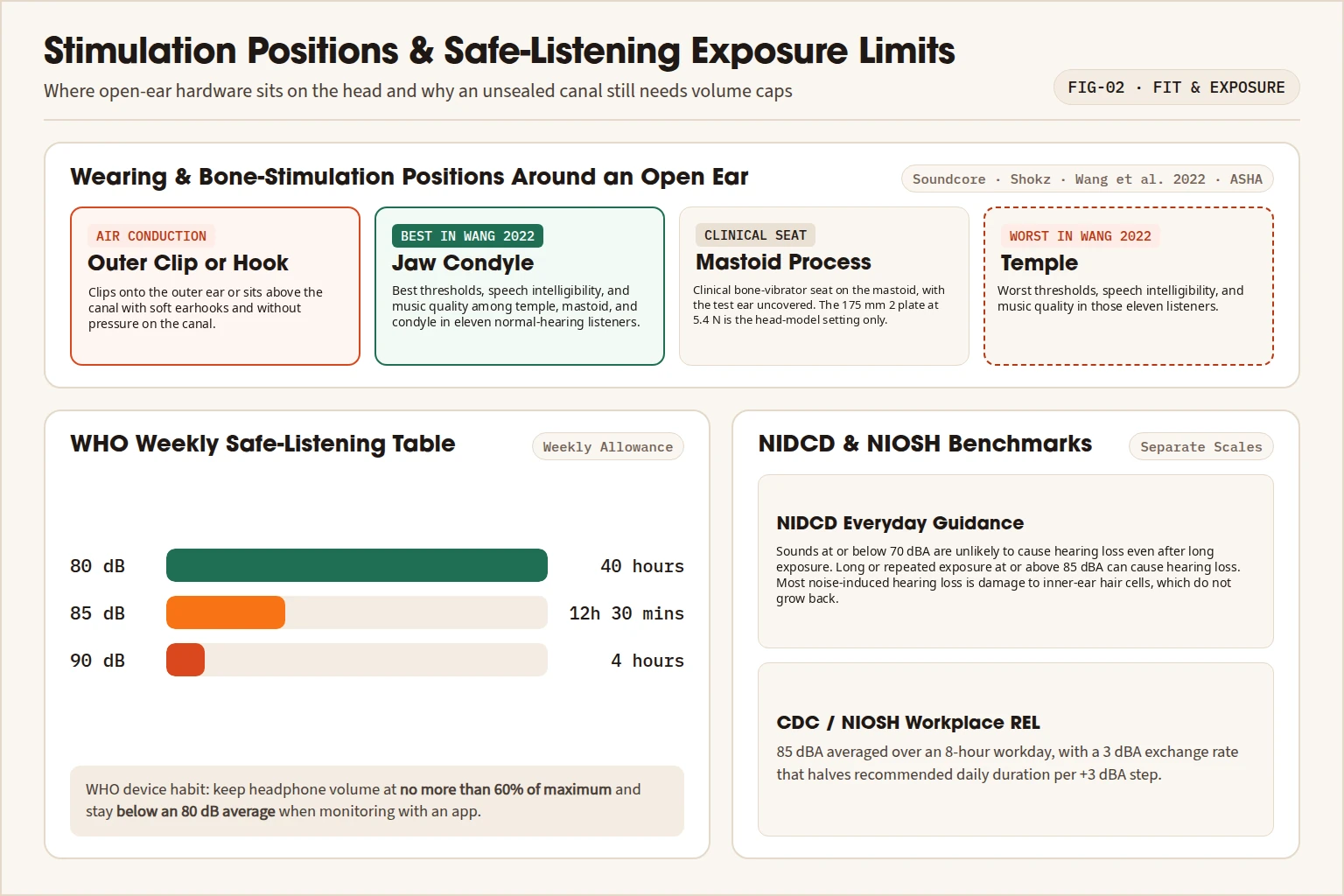
Occupational noise rules measure an eight-hour workday rather than a 40-hour personal-listening week. On the CDC/NIOSH noise and hearing loss page (and summarized in Wikipedia’s headphones article), NIOSH establishes a recommended exposure limit of 85 dBA averaged over an eight-hour workday, using a 3 dBA exchange rate that cuts recommended daily exposure duration in half for each 3 dBA increase and lowers the allowable noise level when daily exposure exceeds 8 hours. As a workplace field cue rather than a headphone leakage distance, CDC notes that 85 dBA sounds often require raising your voice to be heard by someone 3 feet away. In noisy transit or cafeterias, where unsealed earphones let ambient noise in, WHO notes that well-fitted noise-cancelling headphones can reduce the need to raise volume; see our ANC earbuds guide for ear-tip fit.
Outdoor use also has measurable localization limits even when the ear canals stay open. Wikipedia’s headphones article notes that noise-cancelling headphones add extra risk and that several countries and states make wearing headphones illegal while driving or cycling. An IEEE Engineering in Medicine and Biology Conference paper studying robotic-surgery force feedback notes that bone-conduction headphones can provide auditory information without obstructing external sounds, and Wikipedia’s bone conduction entry states that leaving the ears free lets users keep greater situational awareness than with in-ear or over-ear headphones while still leaving them less aware than with no headphones. In an Applied Ergonomics study by May and Walker, the authors note that bone-conduction headphones have been marketed as a safer way to enjoy audio while walking, jogging, or cycling, yet their experiment found greater localization error when distractors played through bone-conduction headphones and concluded that using them can cause a decline in environmental awareness even when environmental sounds remain readily detectable.
Why Does Audiometry Compare Air and Bone Conduction Thresholds?
Clinical audiology pairs air-conduction and bone-conduction measurements to locate where a hearing pathway is obstructed, rather than to grade consumer headphones. According to Wikipedia’s audiometry article, pure-tone audiometry is the gold standard for evaluating hearing loss, plotting air-conduction hearing thresholds in decibels at fixed frequencies between 250 Hz and 8000 Hz for each ear independently alongside a separate set of bone-conduction thresholds at 8 standard frequencies from 250 Hz to 8000 Hz. ASHA explains that air-conduction pure-tone audiometry presents tones through earphones, whereas bone-conduction audiometry uses bone oscillators to vibrate the skull, stimulate the cochlea directly, and bypass problems in the outer and middle ear. Standard clinical bone-vibrator placement sits on the mastoid process or the forehead with proper force applied and the test ear left uncovered and unoccluded, with suspected low-frequency vibrotactile responses noted on the audiogram.
Comparing the two clinical curves reveals whether an obstruction sits ahead of the inner ear. As Wikipedia’s conductive hearing loss entry defines it, conductive hearing loss occurs when sound waves cannot travel efficiently through the outer ear, eardrum, or middle-ear ossicles to reach the inner ear. If hearing sensitivity is markedly better through bone conduction than through the ear canal, audiologists call that difference an air-bone gap and suspect issues in the ear canal, eardrum, or ossicles, and clinical bone-conduction hearing aids on soft or hard headbands or surgical implants can deliver sound through bone to the cochlea.
Consumer open-ear headphones in that comparison did not match the clinical air-bone gap without adjustment. In an International Journal of Audiology mobile-audiometry study, Masalski, Turski, and Zatoński compared a professional B71 bone transducer with commercially available AfterShokz Openmove open-ear headphones for self-measured bone-conduction thresholds. Open-ear headphones in that study showed a test-retest standard deviation of 3.33 dB, while the air-bone-gap regression slope when using the open-ear headphones was 0.67, significantly different from 1.
Which Style Fits Running or Cycling vs a Quiet Office?
Neither open-ear route wins every daily routine: bone-conduction headphones have been marketed for walking, jogging, and cycling, while a quiet office still needs leakage, bass, and comfort checked separately. Use the comparison table below alongside our portable audio and wearables hub and our bone conduction headphones fit and sound leakage guide to match open-ear air conduction or bone conduction to your routine.
| Listening Scenario or Check | Open-Ear Air Conduction (Clip or Earhook) | Bone Conduction (Cheekbone or Temple Pad) |
|---|---|---|
| Acoustic path to the cochlea | Open drivers sit above or in front of the ears and aim airborne waves through the unsealed ear canal to the eardrum and middle-ear bones | Transducers sit on the cheekbones, temples, or skin in front of the canal and vibrate skull bones to reach the cochlea with the canal uncovered |
| Running or cycling outdoors | Flexible ear hooks or outer-ear clips such as Soundcore AeroClip prevent slippage while leaving the canal open | Marketed for walking, jogging, and cycling with free ears for greater awareness than in-ear or over-ear sets, though audio distractors still reduce awareness and localization accuracy |
| Quiet office and desk work | Sits above the ear canals without pressure on the ear canal, while models such as OpenFit 2+ use optimized acoustic ports and directional sound to reduce leakage compared with traditional open-ear speakers | Bone-conduction leakage is not nearly as loud as open-back air-conduction leakage in Shokz’s comparison, though low frequencies may elicit vibrotactile feel that some users find unsettling |
| Bass and frequency fidelity | Uses the ear’s natural acoustics for a broader range of frequencies than bone conduction in maker comparisons, with hardly any ambient noise isolation | Shokz notes headset bass is often particularly thin and that subtle nuances are easier to miss; condyle placement gave the best performance and temple placement the worst |
| Eyewear and loud-transit limits | Soundcore AeroClip attaches to the outer ear; keep device volume at no more than 60 percent of maximum | A behind-the-head band hooks over the top of the ear and shares a narrow slot with prescription glasses, sports sunglasses, and a cycling-helmet cradle; in public transport or a cafeteria, WHO says well-fitted noise-cancelling headphones can reduce the need to raise volume |
Sources
- Wikipedia, Bone conduction
- Wikipedia, Headphones
- Wikipedia, Sound localization
- Wikipedia, Audiometry
- Wikipedia, Conductive hearing loss
- World Health Organization (WHO), Deafness and hearing loss: Safe listening
- CDC / NIOSH, Noise and Hearing Loss
- NIDCD, How Do We Hear?
- NIDCD, Noise-Induced Hearing Loss
- Surendran, Prodanovic, and Stenfelt, Hearing Through Bone Conduction Headsets, Trends in Hearing
- Wang et al., The Effect of Stimulation Position and Ear Canal Occlusion on Perception of Bone Conducted Sound, Trends in Hearing
- May and Walker, The Effects of Distractor Type and Level on Auditory Localization with Bone Conduction Headphones, Applied Ergonomics
- Bonnet, Nélisse, and Voix, Loudness and Acoustic Load Applied to the Ear Canal, Journal of the Acoustical Society of America
- Mikic et al., Bone Conduction Headphones for Auditory Force Feedback, IEEE Engineering in Medicine and Biology Conference
- Masalski, Turski, and Zatoński, Self-Measured Bone Conduction Thresholds Using Open-Ear Headphones, International Journal of Audiology
- American Speech-Language-Hearing Association (ASHA) Practice Portal, Hearing Loss in Adults
- Shokz Canada Blog, Air Conduction vs Bone Conduction
- Soundcore Blog, What Are Open-Ear Headphones
Related Gift Buying Guides
Bone Conduction Headphones Guide: Transducer Clamping Force, Sound Leakage, and IP Rating
Compare open-ear bone conduction headphones by condyle clamping force, 250–500 Hz bass vibration, phase-cancellation sound leakage, and IP55 vs. IP68 water ratings.
Read buying guide
ANC Earbuds Guide: Ear Tip Passive Seal, Occlusion Effect, and Real-World Battery Drain
Explore ANC earbuds through ear-tip fit, the occlusion effect, and a mode-by-mode battery comparison. Use the listening checklist to assess your next pair.
Read buying guide
Waterproof Bluetooth Shower Speaker Guide: IPX7 vs IP67 Ratings and Bathroom Acoustics
Compare IPX7 and IP67 speakers using manufacturer water-care rules, secure mounting, speech controls and fully dry charging connections.
Read buying guide