Bone Conduction Headphones Guide: Transducer Clamping Force, Sound Leakage, and IP Rating
Compare open-ear bone conduction headphones by condyle clamping force, 250–500 Hz bass vibration, phase-cancellation sound leakage, and IP55 vs. IP68 water ratings.
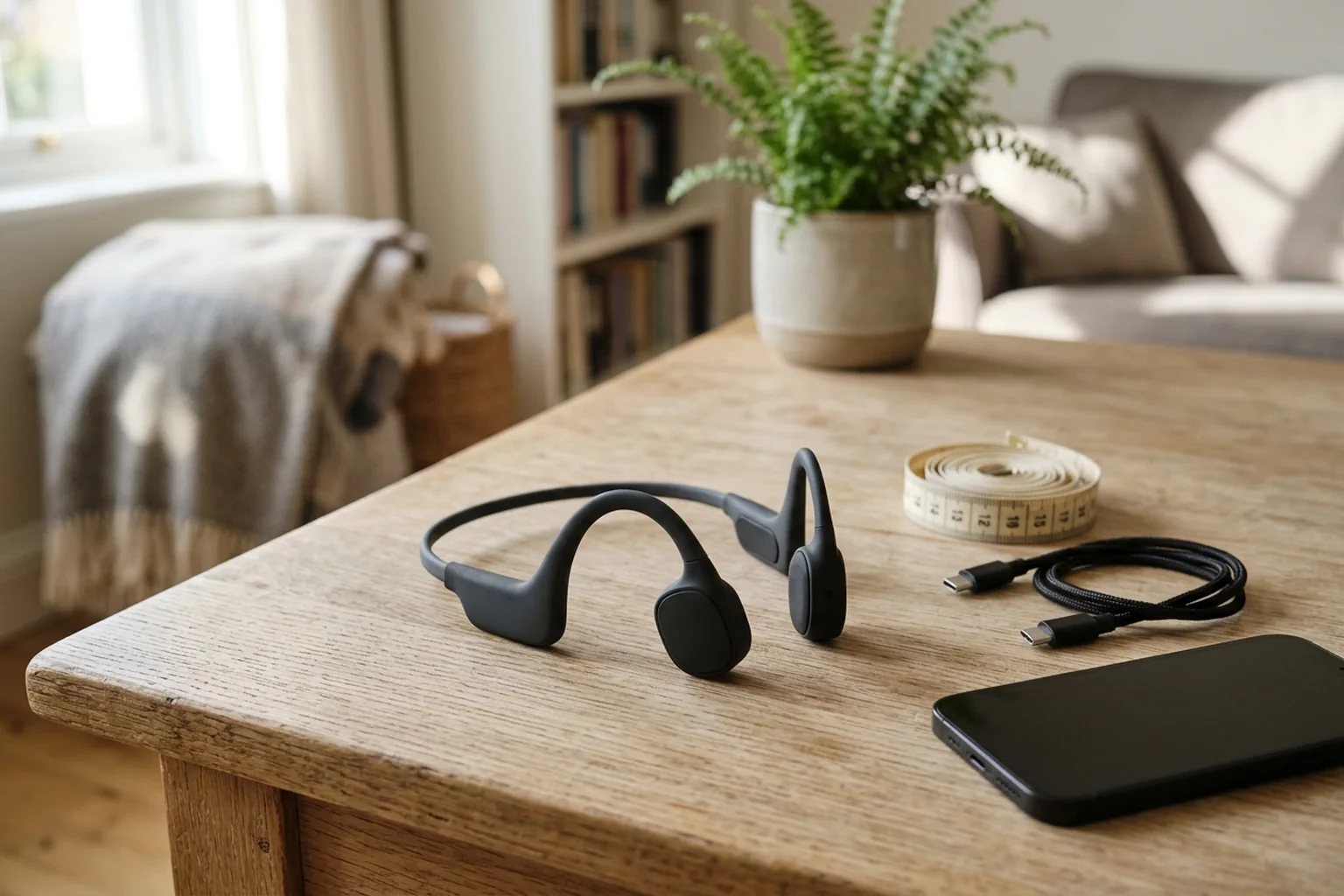
Choosing bone conduction headphones starts with matching the frame’s acoustic driver design, headband clamping fit, and ingress rating to the listener’s real environment. Cranking a bass-heavy open-ear headset in a quiet office causes audible sound leakage for nearby coworkers, while taking an IP55 sweat-resistant running model into a swimming pool risks clogging the air-conduction speaker mesh and losing audio altogether because water blocks Bluetooth radio signals.
Before comparing individual features or wrapping a pair as a gift, separate dry-land running and commuting routines from lap swimming, check whether the recipient needs a Standard or Mini behind-the-head arc, and verify how the transducer pads sit in front of the ear canal alongside eyewear or a cycling helmet.
| Model | Acoustic driver architecture | Water & dust rating (stated conditions) | Battery life & charging interface | Weight & frame sizing | Best routine fit |
|---|---|---|---|---|---|
| Shokz OpenRun Pro 2 | 10th-Gen DualPitch™ hybrid (bone conduction mids/highs + vented air conduction bass driver; Classic bone-only EQ available) | IP55 sweat and rain resistant (excludes swimming, showering, saunas, and seawater) | Up to 12 h playback; 1 h full charge (5-min quick charge = 2.5 h); gasketed USB-C port |
30.3 ± 0.5 g Standard (> 23.5 cm / 9.25 in ear-to-ear arc) or 30 g Mini (≤ 23.5 cm / 9.25 in) |
Dry-land running, road cycling, commuting, and outdoor calls where reduced skin vibration and USB-C charging matter |
| Shokz OpenSwim Pro | 8th-Gen PremiumPitch™ 2.0+ (fully sealed pure bone conduction; no open bass mesh) | IP68 waterproof (continuous submersion up to 2 m in fresh water for up to 2 h) |
Up to 9 h (Bluetooth 5.4) or 6 h (MP3 mode); 1.5 h charge via 4-pin magnetic cable + 32 GB onboard MP3 storage |
27.3 g single-size Standard nickel-titanium alloy frame | Lap swimming, triathlon, and mixed water/land training requiring underwater local MP3 playback |
| Suunto Sonic | Open-ear jawbone sound transducer (L24.2 × W15.1 × H6.2 mm, 6 Ω ± 15% impedance, 117 dB @ 1 kHz sensitivity) |
IP55 sweatproof and weather resistant (-20°C to +60°C operating range; 0°C to +45°C charging range) |
≥ 10 h playback (60% volume, SBC); ≤ 1 h (60-min) full charge (5-min quick charge = 3 h); proprietary charging cable |
31 g (1.09 oz, 102 × 125.5 × 46.5 mm silicone + titanium alloy single-size frame) |
Cold- or wet-weather trail running, hiking, and cycling for athletes using the Suunto outdoor app ecosystem |
Specification sources: Shokz published OpenRun Pro 2 product specifications and FAQ, Shokz official OpenRun Pro 2 vs. OpenSwim Pro technical comparison (September 18, 2026), and Suunto Sonic Black published specification sheet (accessed October 27, 2026).
How open-ear bone conduction headsets couple sound to the ear
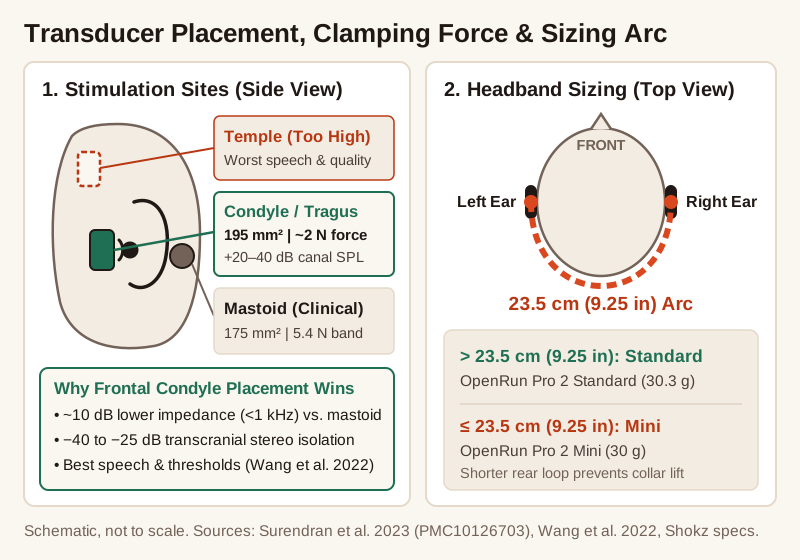
Consumer open ear bone conduction headphones do not sit where clinical audiology bone vibrators sit, and that difference changes how a healthy ear hears them. In clinical bone-conduction audiometry, a circular transducer (175 mm² contact area, such as a Radioear B71 or B81) presses against the mastoid bone behind the pinna. By contrast, commercial wraparound headsets position a rectangular transducer pad (195 mm² on the Aftershokz Aeropex frame analyzed by Linköping University researchers) on the skin immediately in front of the ear canal opening, superior to the area between the mandibular condyle (lower jaw joint) and the tragus.
In Surendran, Prodanovic, and Stenfelt’s 2023 study in Trends in Hearing, Hearing Through Bone Conduction Headsets, probe-microphone measurements across 21 normal-hearing adults and finite-element head simulations (LiUHead, 100 Hz to 10 kHz) demonstrated that this frontal position changes the dominant acoustic pathway. While classical behind-the-ear mastoid stimulation relies primarily on vibrations traveling through the skull bone encapsulating the inner ear, placing the transducer directly in front of an open ear canal vibrates the surrounding soft tissue and ear-canal cartilage. Those local vibrations generate 20 to 40 dB higher ear-canal sound pressure than mastoid stimulation at the same dynamic force.
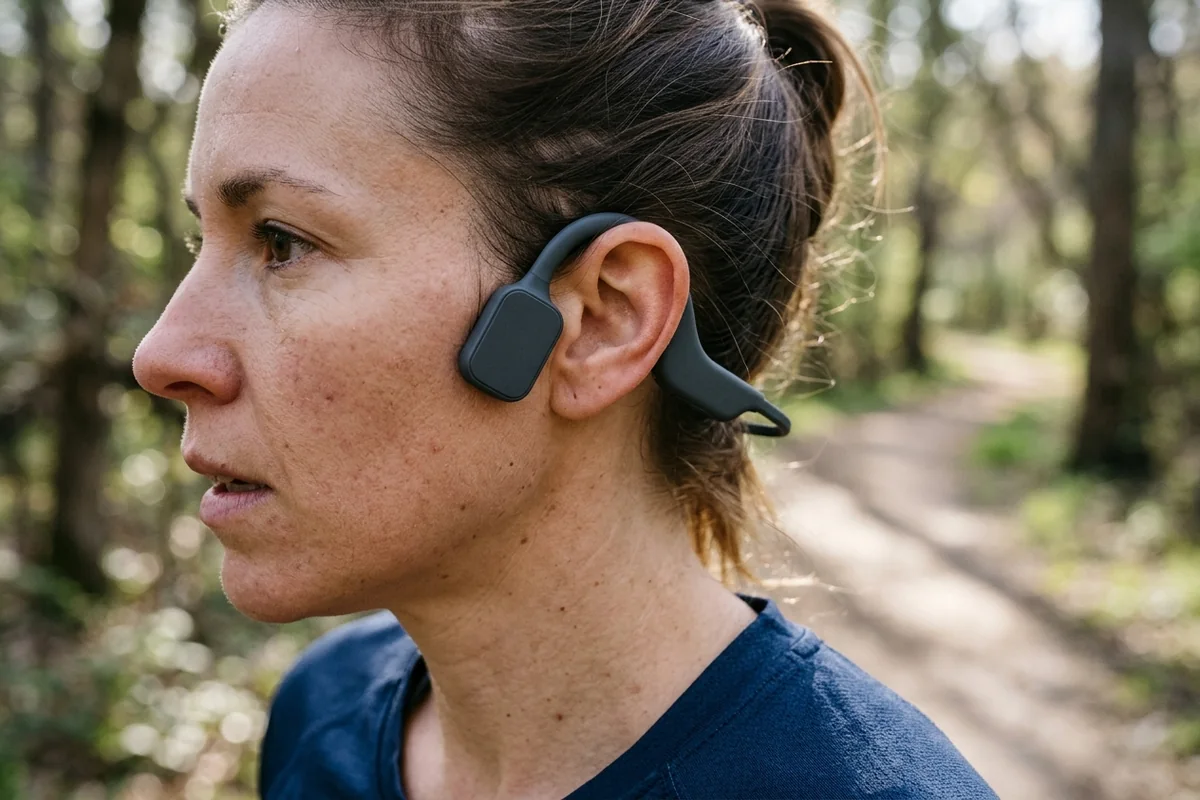
Because that induced ear-canal sound pressure is 20 to 30 dB higher than the internal bony vibration pathways in a normal, unoccluded ear, air pressure inside the open ear canal actually dominates how a healthy listener perceives a commercial bone conduction headset. This yields two practical advantages for everyday listeners:
- Higher sensitivity at lower driving force: Frontal placement near the tragus is 15 to 35 dB more sensitive in hearing threshold force levels than behind-the-ear mastoid placement.
- Clearer stereo separation (binaural cues): When a bone vibrator stimulates the mastoid, vibrations travel across the skull to the opposite cochlea with almost
0 dBof attenuation below1 kHz, blurring left-right stereo separation. At the frontal condyle/tragus position, transcranial transmission drops to −40 to −25 dB, providing enough interaural isolation to preserve directional stereo cues during workouts, calls, and navigation prompts.
Anatomical pad placement also determines whether voices and instruments sound clear or muffled. In Wang and colleagues’ 2022 Trends in Hearing study comparing stimulation positions and ear-canal occlusion, researchers tested 11 normal-hearing listeners across three transducer locations: the condyle (in front of the ear canal), the mastoid (behind the ear), and the temple (above and forward of the ear). Across open-ear threshold measurements, speech intelligibility tests, and music quality ratings for male pop, female pop, and string music, condyle placement achieved the best performance while temple placement produced the worst performance in every category.
Buyer takeaway: Never wear a bone conduction frame tilted upward so the pads rest on the temples or hover over thick hair or glasses frames. The flat face of each transducer must sit squarely on the hard prominence immediately in front of the tragus.
Headband clamping force, sizing math, and low-frequency vibration
For vibrations to cross the skin efficiently without slipping during a run, the wraparound nickel-titanium headband must supply steady inward tension—known as static clamping force. In clinical audiometry and hearing-device verification, a steel headband (such as the Radioear P-3333 used with an IEC 60318-6 artificial mastoid) presses a transducer against the mastoid with a standardized static force of 5.4 N. Tight clamping compresses the skin and subcutaneous layer, stiffening the interface: as summarized in Surendran et al. (2023), adult mastoid mechanical impedance is 3 to 5 dB higher at 5.4 N than at 2 N.
A 5.4 N clamp would quickly cause a tension headache during a one-hour run. Commercial open-ear sports headsets instead use a flexible titanium alloy band that supplies a static clamping force of around 2 N at the frontal position (Surendran et al., 2023). Even at that lighter ~2 N force, the frontal condyle region provides a favorable acoustic coupling surface below 1 kHz, where its mechanical point impedance is around 10 dB lower than at the mastoid. As Nie and colleagues demonstrated in their 2022 Frontiers in Neuroscience study on piezoelectric thin-film force verification, individual variations in skin thickness and contact force directly alter coupled force levels across frequencies, which is why headband sizing and consistent contact pressure matter as much as driver specifications.
How to measure for Standard vs. Mini headband frames
If a wraparound headband is too long for the wearer’s skull, the rear arc sags against the shirt collar during neck extension and allows the front transducer pads to chatter or slide forward off the condyle. Shokz addresses this on the OpenRun Pro 2 (and standard OpenRun) by offering two frame geometries with a precise tape-measure threshold:
- Hold a soft measuring tape at the center of the left ear, wrap it horizontally around the back of the head (following the path where the headband rests behind the ears), and read the distance at the center of the right ear.
- Over 23.5 cm (9.25 inches): Choose the Standard frame (
30.3 ± 0.5 gon OpenRun Pro 2). - 23.5 cm (9.25 inches) or under: Choose the Mini frame (
30 gon OpenRun Pro 2), which shortens the rear titanium loop so the transducers stay anchored against smaller heads without excess rear overhang.
By contrast, dedicated swim and outdoor models such as the Shokz OpenSwim Pro (27.3 g) and Suunto Sonic (31 g, 102 × 125.5 × 46.5 mm) are produced in a single standard frame size. If buying for a teenager or an adult with a petite head circumference (≤ 23.5 cm ear-to-ear arc), verify whether a Mini frame option is required before selecting a single-size model.
Why 250–500 Hz bass causes cheekbone tickle—and how hybrid drivers solve it
First-time bone conduction users frequently notice a physical buzzing or tickling sensation on the skin when listening to bass-heavy music or loud speech at high volume. This is a fundamental biomechanical threshold, not a defective transducer. In Kompis and colleagues’ 2023 study in Audiology Research, Using a Bone Conduction Hearing Device as a Tactile Aid, clinical measurements showed that when bone conduction vibrators are driven at high amplitudes in the low-frequency range (250 to 750 Hz), the skin’s mechanoreceptors detect the mechanical excursion directly as a vibrotactile sensation, with distinct tactile perception occurring at 250 Hz and 500 Hz.
Because reproducing deep bass through bone alone requires large transducer excursion right inside that 250–500 Hz vibrotactile zone, manufacturers use two different engineering paths depending on the headset’s water rating:
- Decoupled hybrid bone + air drivers (DualPitch™): On the Shokz OpenRun Pro 2 (10th-Gen), Shokz splits the frequency spectrum across two distinct drivers in each pod. The bone conduction transducer handles mid and high frequencies—where mechanical excursion is small and vocal clarity is high—while a dedicated air conduction speaker handles low-frequency bass through an acoustic vent directed toward the open ear. Offloading bass from the bone shaker drastically reduces
250–500 Hzcheekbone vibration while deepening low-end response. Listeners who prefer pure vibration transmission can still select Classic EQ mode in the Shokz App (version4.1.4Android /4.1.5iOS or later) to run bone conduction only. - Sealed single-transducer bone conduction (PremiumPitch™ 2.0+): Underwater headsets like the Shokz OpenSwim Pro (8th-Gen) cannot use open air-conduction bass vents because water would flood the acoustic chamber. They rely on a fully sealed pure bone-conduction transducer angled against the cheekbone, trading the vented hybrid sub-bass for complete
IP68submersion sealing.
Why bone conduction headphones leak sound—and quiet-office limits
A common misconception is that because bone conduction vibrates the cheekbone, the audio is silent to everyone else in the room. In reality, bone conduction headphones sound leakage occurs through three physical mechanisms documented in acoustic research and Shokz’s published leakage-suppression engineering notes:
- Airborne radiation from the transducer and vents: Every vibrating housing or hybrid bass port moves the surrounding air like a miniature speaker. In Surendran et al.’s (2023) probe-microphone tests on an Aftershokz headset, airborne sound radiated by the transducer measured 10 to 30 dB below the sound pressure inside the listener’s ear canal at frequencies up to
8 kHz(and only about5 dBbelow at10 kHzand above). - Structure-borne frame vibration: Mechanical vibrations generated by the driver travel into the rigid shell and wraparound frame, turning the exterior casing into a secondary radiating surface.
- Internal housing resonance: Acoustic waves bouncing inside an unsealed or semi-open pod can amplify specific frequencies before escaping through seams or ports.
How 180° phase cancellation and isolation mounts suppress bleed
To keep airborne bleed 10 to 30 dB below the listener’s ear-canal level without sealing the ear canal, modern open-ear headsets combine structural isolation with acoustic phase control:
- Opposite-phase (180° phase-cancellation) acoustic channels: Engineers route controlled rear venting channels around the housing so escaping sound waves exit out of phase (
180°inverted) with the primary outward leakage wave. When the opposite-phase waves meet in the air just outside the pod, destructive interference partially cancels the far-field sound. - Internal damping and driver isolation mounts: Elastomeric suspension mounts and internal damping materials act as mechanical shock absorbers between the vibrating transducer core and the outer shell, preventing the headband frame from resonating like a tuning fork.
- Directional acoustic beaming: On hybrid designs, angled ports guide airborne low-frequency waves directly toward the ear canal opening rather than radiating omni-directionally.
The quiet-office failure mode and how to avoid it
Phase cancellation and damping work best at moderate listening levels (50–60% volume). When a user sits in a silent office, study room, or library and pushes volume above 70%—or activates a heavy bass-boost EQ—two things happen: low-frequency excursion overpowers the housing isolation mounts, and high-frequency airborne bleed (> 4 kHz, where phase cancellation is less uniform) becomes audible as a faint tinny chatter to anyone seated within 1 meter (3 feet). During video calls, excessive leakage can also feed back into the headset’s dual microphones, causing echo or aggressive noise-gate clipping.
To use bone conduction headphones in a quiet shared workspace without disturbing neighbors:
- Keep volume at or below 50–60% (
Suunto Sonicrates its10-hourruntime at60%volume). - Switch from Bass Boost or Volume Boost to Vocal or Classic EQ mode when listening to podcasts, audiobooks, or voice calls indoors.
- If the recipient works in a loud open-plan floor or commutes on a roaring subway where
60%volume is inaudible, open-ear headphones are the wrong tool for noisy transit; ramping volume to drown out ambient roar guarantees both sound leakage and listening fatigue.
IP55 sweat protection vs. IP68 swimming readiness (and underwater MP3)
Comparing a bone conduction headphones ip rating requires reading both digits of the IEC 60529 ingress code alongside the manufacturer’s explicit activity exclusions. As detailed in our waterproof Bluetooth shower speaker IPX7 vs. IP67 guide, the first digit (5 or 6) rates solid-particle and dust protection, while the second digit (5, 7, or 8) rates liquid ingress under strictly defined fresh-water test conditions.
In the bone conduction category, the water rating is directly tied to the driver architecture and charging port:
Why IP55 and IP67 bone conduction models are not for swimming
- IP55 (Shokz OpenRun Pro 2, Suunto Sonic): Protected against dust ingress (
5) and low-pressure water jets or heavy sweat (5). Because the OpenRun Pro 2 uses a vented air-conduction bass driver alongside its bone conduction transducer, Shokz explicitly states that it is not suitable for swimming, showering, saunas, or seawater, warning that water exposure can clog the speaker mesh and muffle sound or microphone pickup. - IP67 on land-only frames (Shokz OpenRun 8th-Gen): Buyers frequently spot the higher IP67 rating on the standard
$129.95Shokz OpenRun (26.4 g,8-hourbattery) and assume it is pool-ready. However, Shokz labels the OpenRun “IP67 Waterproof (Not for swimming)”. Temporary1-meterimmersion protection covers accidental puddles or heavy downpours, not continuous lap-swimming stroke pressure or chlorinated pool immersion, and the OpenRun lacks onboard MP3 storage.
Why lap swimming requires both IP68 sealing and onboard MP3 storage
If the recipient swims laps or trains for triathlons, two hardware features are mandatory:
- IP68 continuous submersion sealing: The Shokz OpenSwim Pro (
$229.95) uses a fully sealed housing (PremiumPitch™ 2.0+pure bone conduction without an open bass grille) rated IP68 for continuous submersion up to 2 meters in fresh water (for up to2 hours). - Onboard MP3 storage (
32 GBon OpenSwim Pro): Standard2.4 GHzBluetooth radio waves attenuate rapidly in water—the moment a swimmer’s head submerges, a phone left on the pool deck or strapped to a swim buoy loses its Bluetooth link. The OpenSwim Pro solves this by pairing Bluetooth 5.4 (up to 9 hoursbattery on land) with 32 GB of built-in flash storage and a dedicated MP3 mode (up to 6 hoursbattery underwater). Swimmers stream from a phone while running or cycling, then hold the mode control to switch to local MP3 files before entering the pool.
Dry-port charging rules and cold-weather temperature limits
Charging interfaces also differ across IP ratings. The Shokz OpenRun Pro 2 uses a convenient USB-C port protected by a hinged rubber cover (DC 5V input, cable included), whereas the Shokz OpenSwim Pro uses a sealed 4-pin magnetic induction cable (which also transfers MP3 files from a computer) and the Suunto Sonic uses a proprietary clip/magnetic charging cable.
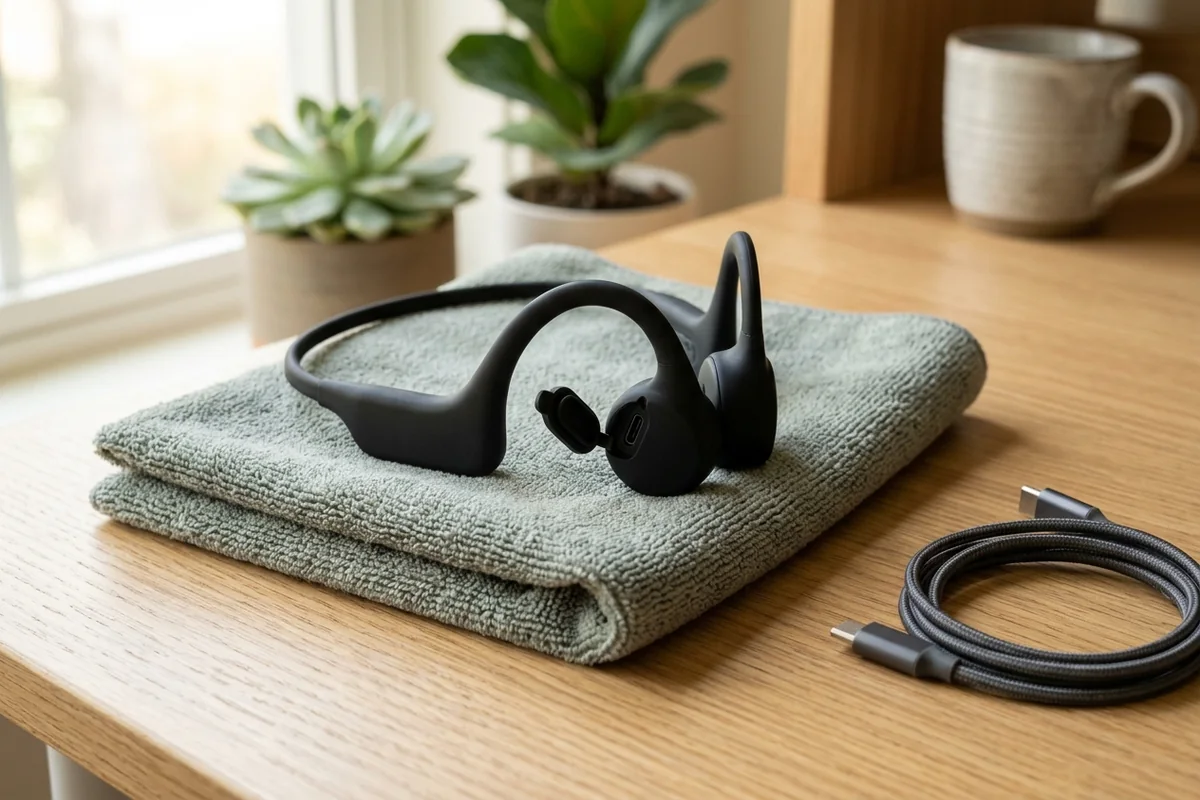
Regardless of whether the headset uses USB-C or magnetic pins, follow three post-workout care rules from the manufacturer manuals:
- Shake, wipe, and air-dry before plugging in: If an OpenRun Pro 2 gets wet from sweat or rain—or if its microphone sounds muffled—Shokz instructs owners to gently shake the headset several times at different angles, wipe the speaker mesh and microphone ports with a dry cloth or absorbent tissue, and leave it in a ventilated area for several hours to air-dry completely before charging.
- Snap the USB-C gasket firmly shut: Before heading back outdoors with an OpenRun Pro 2, apply firm finger pressure to the rubber USB-C port cover until it snaps flush with the housing so sweat cannot wick into the connector.
- Respect cold-weather lithium-ion charging limits: The Suunto Sonic is rated to operate and store in extreme outdoor temperatures from -20°C to +60°C (-5°F to +140°F), making it well suited to winter trail running or alpine touring. However, its recommended charging temperature is strictly 0°C to +45°C (+32°F to +113°F). Just as we cover in our ultralight backpacking power bank cold-weather guide, never charge a cold-soaked lithium-ion headset battery below freezing (
0°C / 32°F); let the headset warm to room temperature indoors first.
Situational awareness, eyewear/helmet fit, and pre-purchase verification
Leaving the ear canals open helps runners, cyclists, dog walkers, and parents hear approaching bike bells, footsteps, or household conversation. However, open-ear geometry is not an automatic safety guarantee. Both Shokz and Suunto warn that listening at high volumes can still mask oncoming traffic and emergency sirens, and some cycling events or local road laws restrict headphone use regardless of transducer type. Treat open-ear awareness as a reason to keep outdoor volume moderate, not an excuse to tune out road hazards.
Checking clearance with glasses, sunglasses, and cycling helmets
Because a bone conduction headband hooks over the superior root of the pinna (where the top of the ear meets the side of the head), it shares a narrow anatomical slot with prescription glasses, sports sunglasses, and cycling helmet retention cradles.
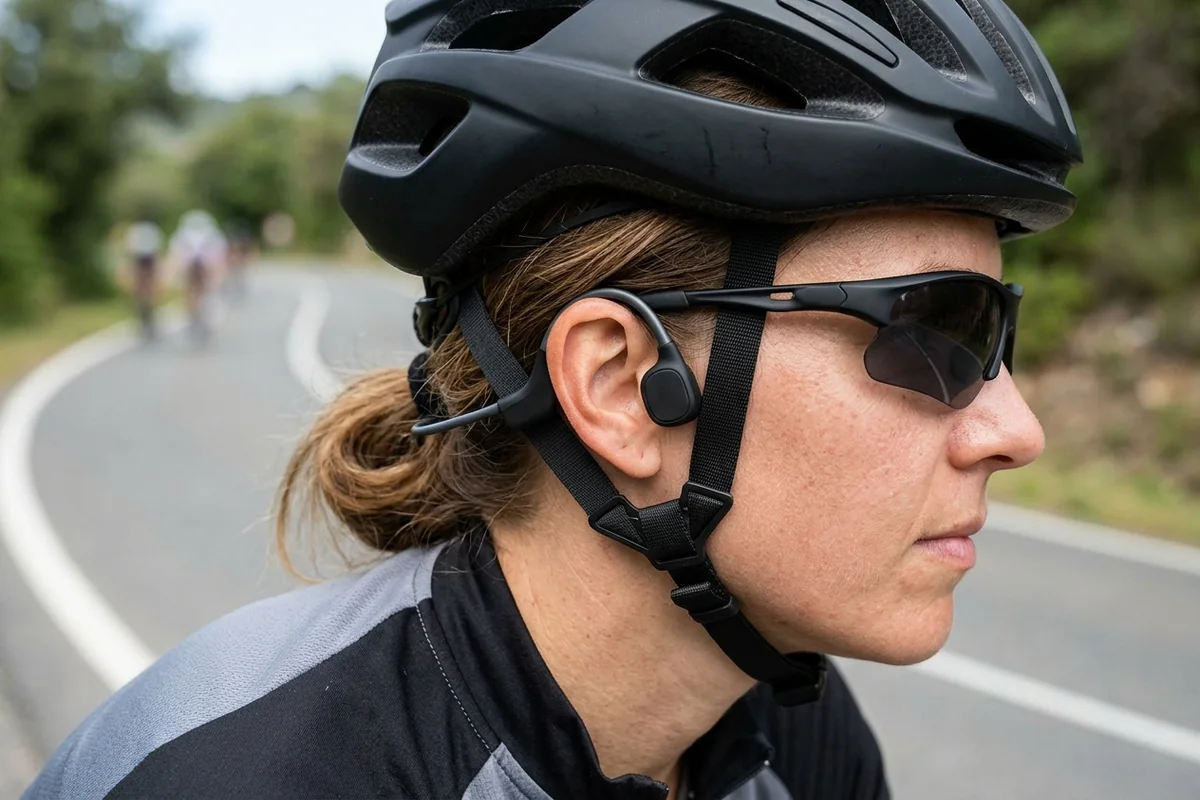
When testing fit with eyewear and headgear, check three mechanical interactions:
- Eyewear temple arm stacking: Put the bone conduction headphones on first so the silicone ear hook rests directly in the crease at the top of the ear and the transducer pad sits flat against the skin in front of the tragus. Then slide glasses or sunglasses arms on outside or slightly above the headphone hook. Sliding thick acetate glasses arms underneath the transducer pad lifts the pad off the skin and severs the mechanical coupling path.
- Cycling helmet Y-strap and rear dial cradle: Adjust the helmet’s side Y-straps so the front strap passes cleanly in front of or over the transducer module without pinching it into the jaw joint. Check the rear occipital retention dial at the back of the helmet: if the dial sits low on the skull, tilt the head backward (as when riding in the drops on a road bike) to confirm the helmet cradle does not push down on the headset’s rear titanium loop and lever the front pads up onto the temples.
- High collars, winter beanies, and gym benches: Because the titanium arc floats a short distance behind the neck, lying flat on a weight bench, resting against a tall office-chair headrest, or wearing a stiff winter jacket collar can push the rear band forward. If the recipient primarily lifts weights lying supine or wears thick winter headgear, a Mini frame (
≤ 23.5 cmear-to-ear arc) reduces rear loop projection.
Wearable Audio Fit & Sound Leakage Verification Checklist
When giving bone conduction headphones as a gift—or evaluating a new pair at home—keep the gift receipt and original box intact (Shokz offers a 45-day return window on direct orders) and run through this five-step verification checklist during the first week:
| Check step | How to test (with packaging preserved) | Pass criterion | Action if check fails |
|---|---|---|---|
| 1. Ear-to-ear tape measurement | Measure with a soft tape from the center of the left ear around the back of the head to the center of the right ear | > 23.5 cm (9.25 in) matched to Standard frame; ≤ 23.5 cm (9.25 in) matched to Mini frame | Exchange Standard for OpenRun Pro 2 Mini (or vice versa) if the rear band sags onto the collar or pinches the temples |
| 2. Condyle vs. temple pad contact | Look in a mirror with the headset worn normally and jaw relaxed, then open and close the mouth slightly | Both rectangular pads sit flat on the prominence immediately in front of the tragus (condyle), leaving the ear canal open |
Reposition the ear hooks lower behind the pinna; ensure hair or glasses arms are not trapped under the transducer face |
| 3. Eyewear, helmet & head-tilt stack | Put on everyday glasses, sunglasses, and cycling helmet; tilt head 30° back and turn left/right |
Rear titanium arc does not strike the helmet cradle or lift the front pads up toward the temple (Wang et al. 2022 worst zone) |
Place headphone hooks on before eyewear; raise the helmet rear cradle one notch or switch to a Mini headband |
| 4. One-meter quiet-room leakage & buzz check | Play a familiar podcast and a bass-heavy track at 50–60% volume in a quiet room; have someone stand 1 m (3 ft) away | Bystander at 1 m cannot make out spoken words; listener feels clear audio without uncomfortable 250–500 Hz cheekbone tickle |
Switch from Bass Boost to Classic or Vocal EQ mode; if used in a silent library, lower volume below 50% |
| 5. Water boundary & dry-port care check | Confirm whether the user swims laps versus sweats on land, and inspect the charging port flap or magnetic pins | Land runners use IP55/IP67 with USB-C cover pressed flush; swimmers use IP68 (2 m fresh water) with 32 GB MP3 mode |
Never take IP55 (OpenRun Pro 2, Suunto Sonic) or IP67 (OpenRun) into a pool or shower; shake dry and air-dry before charging |
For a broader look at how open-ear headphones fit alongside waterproof speakers, item trackers, and compact projectors, explore our portable audio and outdoor tech hub. If you are weighing two finalists across different daily habits or planning a complete gift bundle with charging accessories, use our routine-based gadget comparison worksheet and the tech gift buying guides hub.
Related Gift Buying Guides
Waterproof Bluetooth Shower Speaker Guide: IPX7 vs IP67 Ratings and Bathroom Acoustics
Compare IPX7 and IP67 speakers using manufacturer water-care rules, secure mounting, speech controls and fully dry charging connections.
Read buying guide
How to Choose a Phone Charger as a Useful Gift
Choose a phone charger by device requirements, supported charging profiles, shared port output, cable compatibility and safe placement.
Read buying guide
How to Choose a Phone Stand as a Useful Gift
Choose a desk phone stand by phone and case fit, viewing position, stability, cable access and storage space.
Read buying guide