Best Power Bank for Backpacking: Ultralight Wh-per-Gram Math and Sub-Zero Cold Weather Performance
Compare backpacking power banks by nominal and rated energy, carried mass, recharge input, wet-weather care and manufacturer cold-temperature limits.
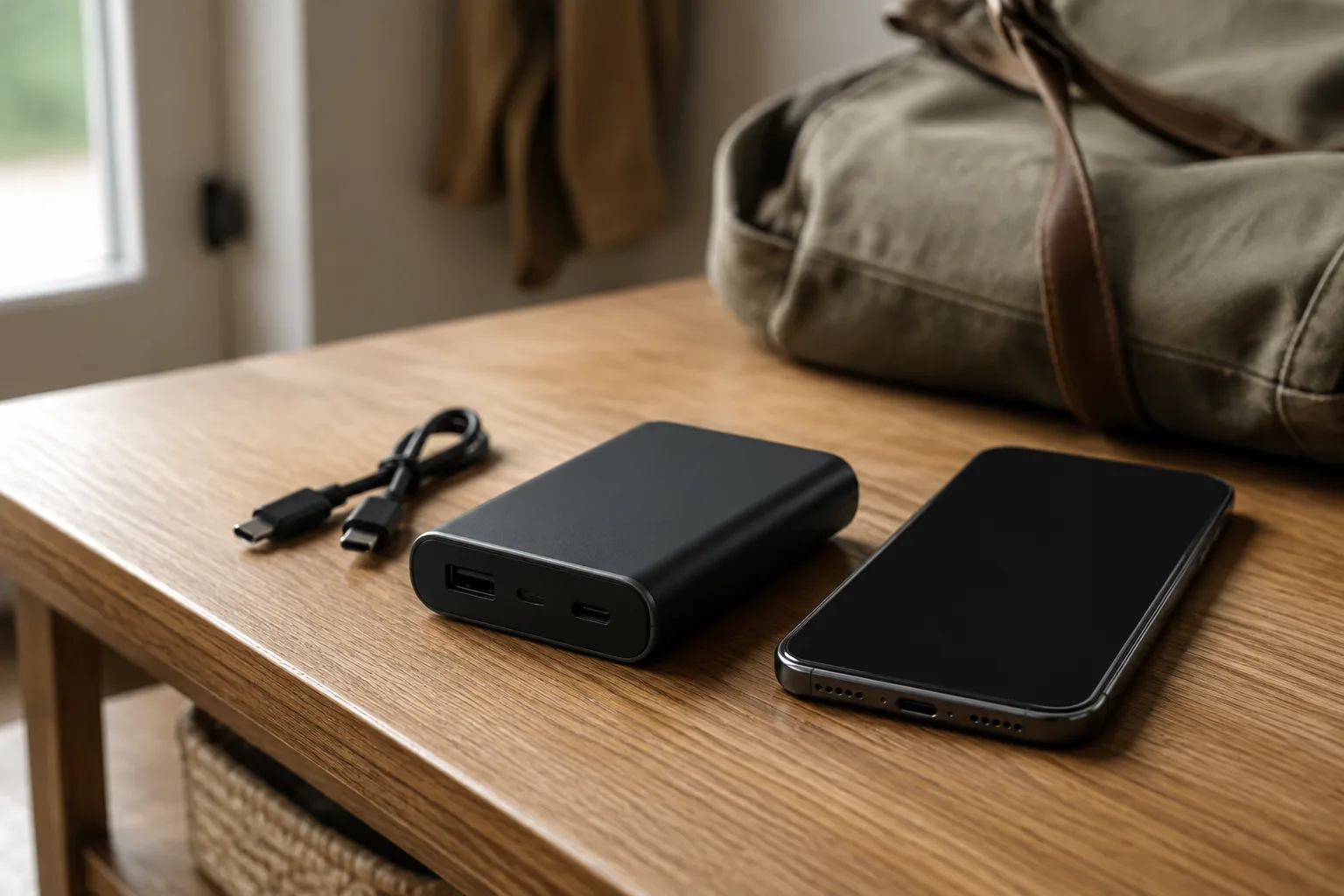
The best power bank for a backpacking trip is the one that covers the planned charging needs and reserve while fitting the pack’s weight and weather constraints. Compare energy in watt-hours, not just milliamp-hours. Then check usable output ratings, charging speed in both directions and the conditions under which the bank will be carried and recharged.
Start with the actual kit: phone, navigation device, headlamp, watch and any communicator. List which items need a cable and which use replaceable batteries. Count the days between dependable charging opportunities, including a contingency for a delayed return or unavailable outlet. Keep essential navigation and emergency communication plans independent of an optimistic recharge estimate.
Separate nominal energy from USB output
Milliamp-hours express charge at a specified voltage. Energy in watt-hours equals capacity in amp-hours multiplied by that voltage. When a maker gives both nominal cell capacity and a rated output capacity, record the voltage and test current beside each number.
Nitecore’s published NB10000 Gen 2 specification states 10,000 mAh at 3.85 V, or 38.5 Wh. It separately lists 6,400 mAh at 5 V at a typical 1 A load, equivalent to 32 Wh at that output rating. Those two figures describe different points in the energy path.
The CARBO 20000 specification lists 20,000 mAh at 3.85 V, or 77 Wh, and rated output of 13,500 mAh at 5 V at a typical 2 A load. That output figure corresponds to 67.5 Wh. Because the listed test currents differ, avoid treating the two rated-output numbers as a controlled efficiency contest.
Energy is also used by the receiving device and lost during its charging process. Anker’s explanation of rated capacity describes why the internal capacity headline differs from what reaches a device. Dividing bank mAh by phone mAh alone leaves out both the voltage relationship and the charging path.
Compare identified model generations
| Manufacturer specification | NB10000 Gen 2 | CARBO 20000 |
|---|---|---|
| Nominal energy | 38.5 Wh | 77 Wh |
| Stated mass | 150 g | 295.5 g ± 5 g, accessories excluded |
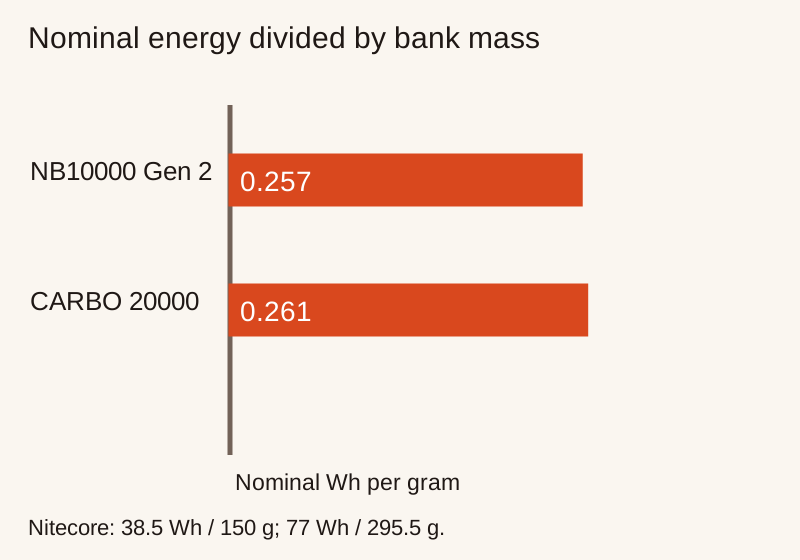
| Calculated nominal energy per gram | 0.257 Wh/g | 0.261 Wh/g using 295.5 g |
| Rated 5 V output capacity | 6,400 mAh at typical 1 A | 13,500 mAh at typical 2 A |
| USB-C input profiles | 5 V/2.4 A; 9 V/2 A | 5 V/2.4 A; 9 V/2 A |
| USB-C output maximum | 20 W | 20 W |
| Combined output | 5 V/3 A, 15 W maximum | 5 V/3 A maximum |
| Published ingress rating | IPX5 | IPX5 |
These are the two Nitecore pages linked above. The NB10000 page explicitly identifies Gen 2. Match the generation and printed model label before applying these figures to a product listing. A later generation may change the ports, power profiles or output rating even when the headline capacity is similar.
The nominal Wh/g result comes from dividing the listed energy by the stated mass. It describes the bank itself. Add the cable, pouch and any charger that will actually travel to compare complete carried systems. A lighter bank with a bulky extra cable can narrow its advantage once the whole kit is on the scale.
Build the trip budget from familiar use
Before a remote trip, observe the kit on an ordinary outing or practice day with similar navigation and screen use. Record which devices need charging and how much reserve remains. Cold conditions, camera use, weak mobile reception and more frequent screen checks can change the demand.
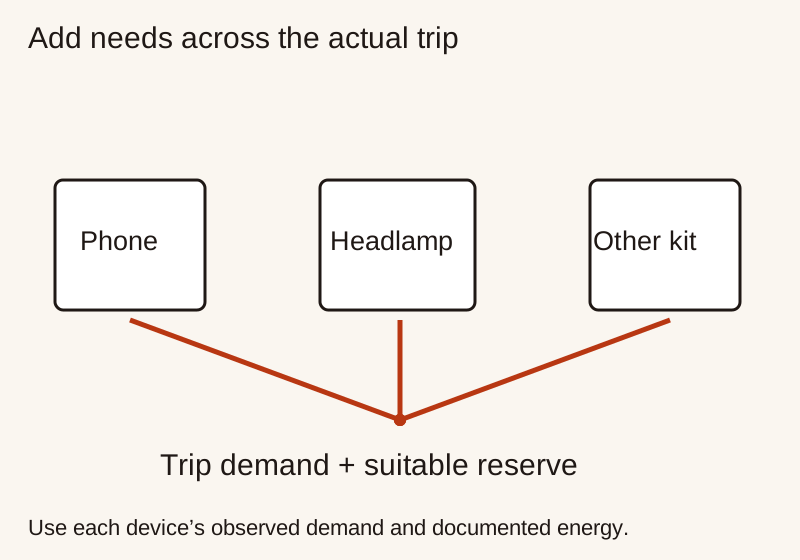
Use a simple worksheet: device, observed daily charging need, days to the next dependable outlet, cable type and reserve requirement. Keep the units consistent. A percent display is useful for observing one device but is not an energy unit that can be added directly across a phone and a headlamp.
When the device’s battery energy is documented, watt-hours can help organize the plan. Still allow for charging losses and ongoing device use. For critical equipment, follow its manufacturer’s operational guidance and carry the recommended backup arrangements. A paper route, spare lighting or separate navigation method can address failures that a larger USB bank alone cannot.
Avoid choosing a pack solely from a promised number of phone recharges. Check which phone, settings and conditions support the claim. A camping trip with occasional messages is different from a day of navigation, photographs and video. Your own preparation should resemble the intended use closely enough to guide the reserve choice.
Check cold-weather operating limits
Cold temperatures can reduce lithium-ion performance through changes in transport and reaction processes. The low-temperature lithium-ion literature summarized in PubMed discusses reduced available performance and charging risks, including lithium plating. The size of the effect depends on the cell and operating conditions.
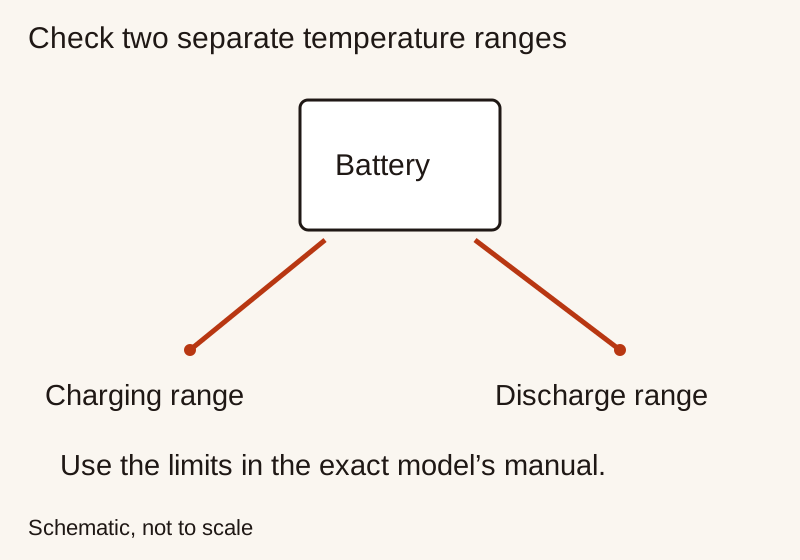
For a consumer power bank, follow the model’s stated charging, discharging and storage ranges separately. A discharge range extending below freezing does not automatically permit charging there. Keep a cold bank disconnected from charging until it is within the manufacturer’s allowed charging range and the connectors are dry.
Carry the bank where it is protected from rain, impact and extreme cold while keeping it accessible for inspection. If moving from cold air into a warm shelter produces condensation, allow the equipment and connections to dry before charging. Avoid direct heaters or other improvised rapid-warming methods.
Specialized cold-weather products need their own instructions. A heating feature can change how a pack operates and how much stored energy is available for external devices. Compare the documented behavior of that exact model instead of extending its rating to ordinary banks in the same brand family.
Stop using a bank that is swollen, leaking, visibly damaged or unusually hot. Follow the manufacturer’s disposal and recall instructions. The US CPSC recall database can be searched by model for a US purchase; use the relevant authority for the market where the product is sold.
Count recharge input as well as output
Output wattage governs the bank’s ability to supply a connected device. Input profiles govern how it recharges from a wall adapter. A high output headline does not tell you how much reserve can be restored during a short stop.
The two Nitecore reference pages list a 9 V/2 A input profile. Use a compatible adapter and cable that can provide the required input. Then read the maker’s full-charge estimate and conditions. Charging generally changes as the battery fills, so dividing capacity by peak input power is not an exact finish time.
When charging two banks from a multi-port adapter, read the adapter’s simultaneous-output table. A total rating alone does not establish that both ports will supply the desired profile together. Our phone charger guide shows how Apple documents different device allocations on its 35 W dual-port adapter.
At a busy resupply stop, consider outlet access and how the equipment will be supervised. Keep chargers ventilated and away from bedding or closed bags. A compact kit that uses one dependable connection may be easier to manage than several adapters competing for outlets.
Verify small-device charging and cables
A watch or small headlamp may behave differently from a phone when connected to a bank. Check whether the bank offers a documented low-current mode, how to activate it and whether it shuts off automatically. Try the actual device and cable before relying on the combination on trail.
Pack the required proprietary leads as well as USB-C cables. Inspect connector fit and strain relief, and keep exposed contacts protected from dirt and moisture. A short cable is convenient in a pouch only if it can reach comfortably without pulling on either port.
For two devices charging together, use the combined-output specification. The Nitecore reference models list a shared 5 V/3 A output, distinct from their single-port maximums. Plan the charging sequence if one device needs a different profile or if simultaneous charging reduces useful speed.
Flying to the trailhead
The FAA PackSafe battery guidance requires spare lithium batteries, including power banks, in carry-on baggage with terminals protected. Remove them if the carry-on is gate-checked. Its normal lithium-ion size limit is 100 Wh; certain larger spares up to 160 Wh require airline approval and are limited in quantity.
The operating airline and destination rules may be stricter, including limits on quantity or use onboard. Check the carrier before travel and keep the Wh label readable. The 38.5 Wh and 77 Wh reference packs are below the FAA’s normal size threshold, but that does not replace the other packing and carrier checks.
Finish the kit before giving it
For a gift, ask which devices the recipient already carries and whether a lightweight bank is a wanted addition. Include the correct cables, the model-specific instructions and an exchange receipt. Let them test the setup before the departure date.
Explore the tech gift buying guides for the rest of the charging kit, or use the everyday power bank guide when the main use is commuting rather than backcountry travel.
Record the final packed weight
Weigh the bank together with the cables and weather protection that will actually travel. Keep that complete-kit figure beside the energy budget so the comparison reflects the pack the hiker will carry.
Related Gift Buying Guides
How to Choose a Power Bank as a Gift
Choose a power bank for the recipient’s devices, daily charging needs, carrying space and travel requirements.
Read buying guide