How to Choose a Power Bank as a Gift
Choose a power bank for the recipient’s devices, daily charging needs, carrying space and travel requirements.
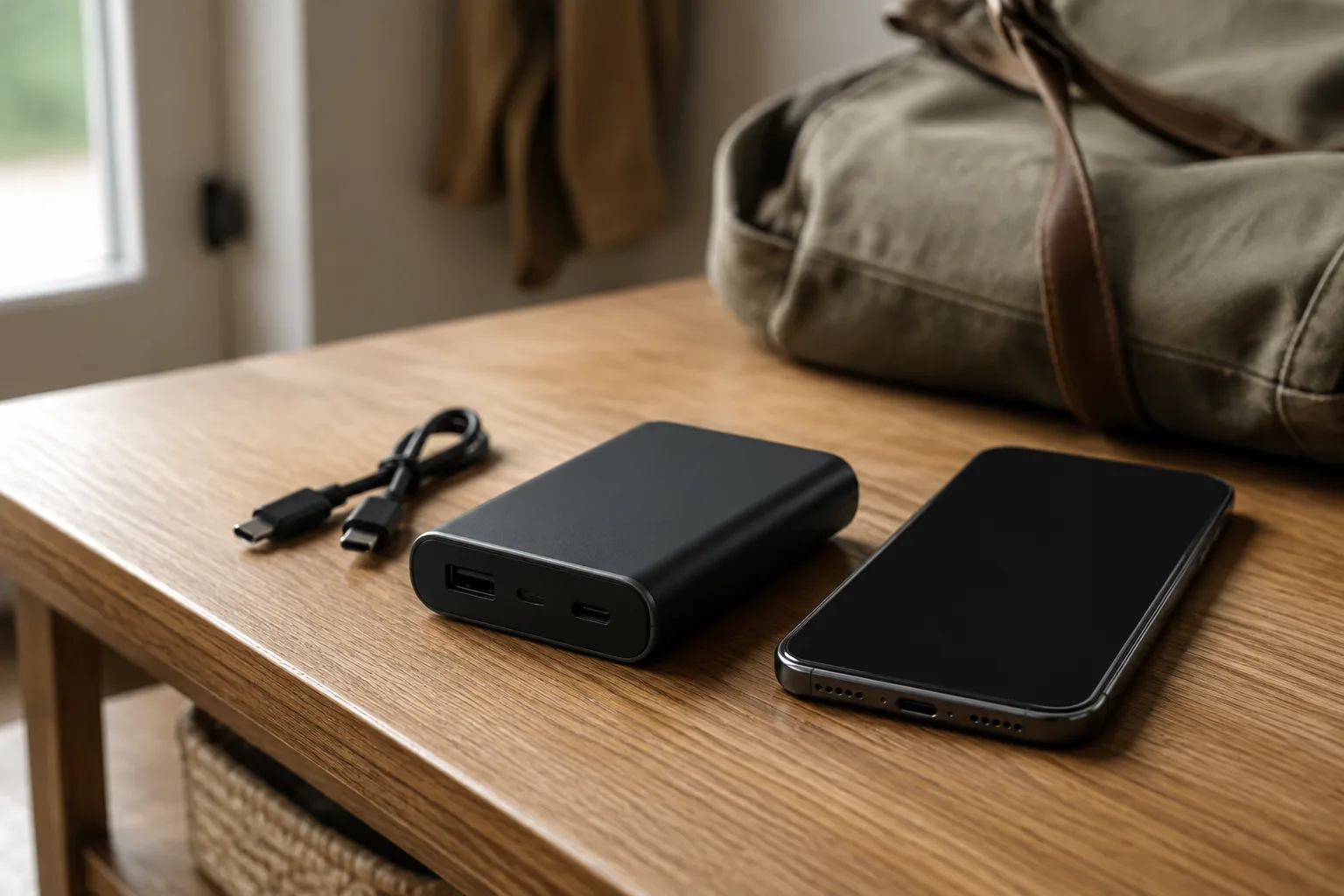
To choose a power bank as a gift, identify the recipient’s main device, the bag they actually carry, and the time they spend away from an outlet. Then compare compatible output, usable reserve, cable requirements and the effort of recharging the bank itself. For a phone-only gift, a modest bank that travels every day can be more valuable than a heavy laptop model that stays at home.
Start with the moment the gift needs to solve
Ask what happens when the recipient runs low. A commuter might need enough reserve to keep tickets, messages and maps available until home. A photographer on a weekend walk might need to top up a phone while taking pictures. Someone working between meetings might want to keep a laptop running through an uncertain afternoon. These are different gifts, even if the shop groups them under the same heading.
Write a one-sentence brief before browsing: “This should live in a small shoulder bag and support one phone through a long day.” That brief gives you a useful reason to reject an oversized device. If you do not know the person’s routine well enough to write it, ask about their usual charger or look for another gift category. Our guide to choosing technology gifts around real routines helps with that earlier decision.
Think about ownership as well as emergencies. A spare battery creates a second battery to remember. Someone who already recharges accessories each evening may welcome it. Someone who regularly loses small objects might prefer a bank with a clearly visible indicator and a dedicated pocket in their bag. More reserve does little good if the bank is empty when needed.
Choose the form before chasing capacity
Use the table to shortlist a carrying format, then compare the exact dimensions, weight and charging specifications.
| Recipient’s routine | Start by comparing | Main compromise | Reject an option when |
|---|---|---|---|
| Phone top-ups during a normal day | Compact phone-focused banks | Less reserve in exchange for easier carrying | It will not fit the everyday pocket or bag |
| Long days using maps and a camera | A larger reserve with a clear indicator | More weight and another item to recharge | Its output does not match the phone’s requirements |
| Shared charging on a family outing | Multiple outputs with documented power sharing | Convenient sharing can reduce power per device | The manual omits simultaneous-output behavior |
| Laptop work away from sockets | Explicit laptop compatibility and suitable output | Greater bulk and a more demanding recharge setup | Only the total output is advertised |
Draw the shortlisted model’s dimensions on paper and compare the outline with the intended pocket. Check whether a protruding plug or attached lead changes that fit. This takes a minute and is often more revealing than a lifestyle image that gives no scale. If two options meet the electrical requirements, favor the shape the person will willingly carry.
Understand what the capacity label does and does not say
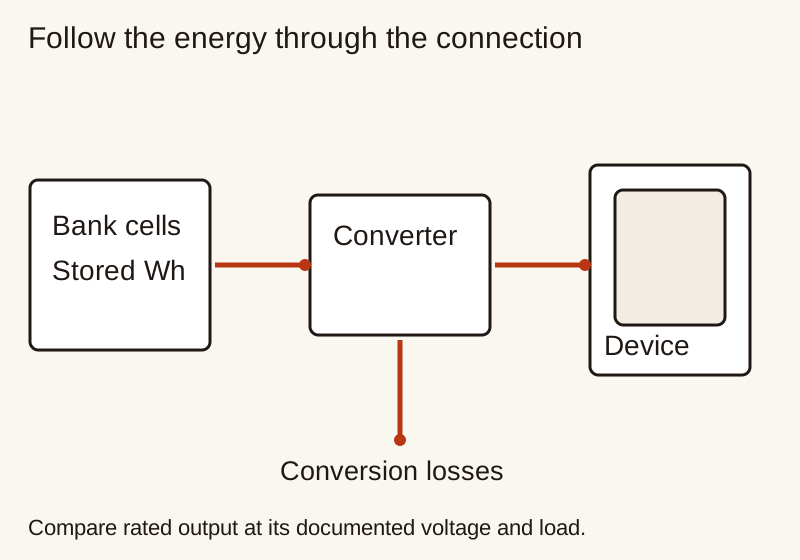
Milliamp-hours measure charge; comparing stored energy also requires voltage. Anker’s explanation of rated and internal capacity distinguishes the cell-level figure from energy delivered after voltage conversion and device charging losses. A bank’s mAh number divided by a phone’s mAh number is therefore not a reliable promise of full recharges.
For gift shopping, use this distinction to ask better questions. Does the manufacturer state test conditions for its recharge estimate? Was the phone idle or being used? Is the estimate for your recipient’s model? A less dramatic claim with clear conditions is more useful than an unexplained promise. Keep a note of unknowns in your comparison rather than filling the gaps with optimistic assumptions.
Check compatibility at both ends of the cable
Record the exact phone or laptop model. “An iPhone” or “a USB-C laptop” leaves too much unanswered. Look up the device maker’s charging requirements and compare them with the power bank’s supported output. A matching connector is a necessary physical connection, but it does not establish every charging capability.
Apple’s iPhone fast-charge documentation illustrates why the model matters: it distinguishes USB-C cables for iPhone 15 and later from USB-C-to-Lightning cables for earlier models, and describes compatible USB Power Delivery adapters. Treat its charge-time figures as results under Apple’s stated conditions, not guarantees for every portable bank. The same habit applies to another manufacturer: start with its documentation for the specific device.
For a laptop gift, ask whether the bank’s relevant port supports the machine’s required charging profile. Also read the bank’s simultaneous-output table if a phone will be connected alongside it. Do not equate a headline total wattage with the power available from one port. If a seller cannot provide the details, leave that option off the shortlist until the manufacturer clarifies them.
Make the cable part of the gift
For a separate cable purchase, use our USB-C cable gift checklist to distinguish power capability, other intended tasks and physical fit.
A good battery paired with the wrong cable creates an unfinished present. List both connector ends and the power capability you need. Decide whether the cable will be used with a phone held in the hand, inside a bag, or beside a laptop on a table. A short lead may keep a pocket setup tidy, while a longer lead gives more placement freedom at a desk.
The USB-IF cable certification guidance explains that cables have different capabilities and that its USB-C-to-USB-C compliance program uses 60 W or 240 W power markings. Those are cable capability markings; they do not make a connected phone charge at that power, or prove that a bank has the same output. Check the cable and the connected products separately.
Built-in cables are an appealing gift feature when the recipient often forgets a lead. Before choosing one, investigate what happens if that cable becomes damaged. Is there a separate output port for an ordinary cable? Is the attached connector useful for the recipient’s next likely device? A removable cable can be easier to replace, while an integrated one can be easier to remember. This is a practical tradeoff, not a universal winner.
Decide whether magnetic charging solves a real problem
A magnetic bank may suit someone who wants to hold a phone and battery together without managing a loose lead. Before buying, check the exact phone, case and bank combination. Ask the manufacturer whether the phone supports the advertised wireless charging mode, whether a particular case is required, and what happens when charging through that case.
Think about how the person uses the phone. Will an attached battery get in the way of their grip, camera use, stand or car mount? Would they rather place the battery in a bag and connect a cable? A convenient attachment in a product photo might be an awkward object during a long call. If wireless convenience is not part of the recipient’s routine, there is no reason to pay extra just to make the gift look more advanced.
Budget for recharging the power bank itself
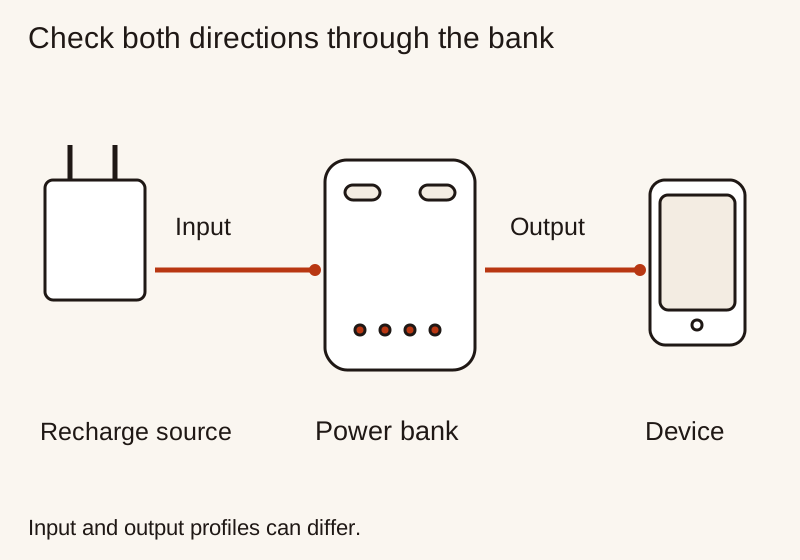
Compare input specifications as carefully as output. The product needs to fit the recipient’s existing wall-charging setup as well as their phone. Check the box contents: a cable and a wall adapter are different items, and an included cable does not establish that the recipient already owns a suitable adapter.
There is no need to add every accessory. A bank and one appropriate cable may be sufficient. Our gadget comparison framework helps separate necessary features from extras, while the desk gift guide is useful when the charging problem mainly happens at a workstation.
Check travel requirements for the actual itinerary
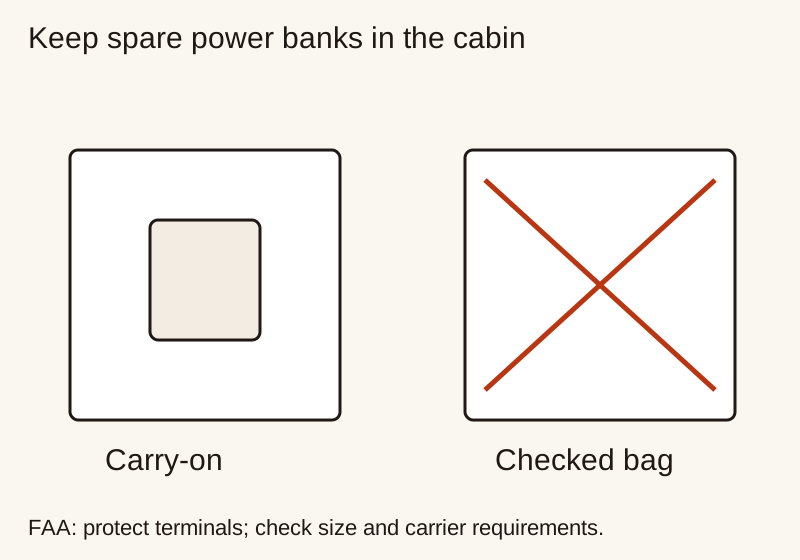
For US air travel, the FAA’s passenger battery guidance requires power banks to travel in carry-on baggage, protected against damage and short circuit. Its baseline limit is 100 Wh per battery; certain larger batteries up to 160 Wh require airline approval. The FAA explicitly notes that airlines and international rules may be stricter. Check the operating carrier’s current requirements before travel, including any quantity or onboard-use restrictions.
Do not write “airline approved” on the gift note as a blanket assurance. Instead, keep the manufacturer’s documentation and make sure the Wh marking is readable. A gift for a frequent traveler should make these checks easier. If the model label is unclear, ask for clarification before purchasing rather than expecting the recipient to explain an ambiguous battery at an airport.
Check the exact model and seller before checkout
Brand familiarity is not a substitute for checking a particular product. For a US purchase, search the CPSC recall database and the manufacturer’s recall page using the model number, then follow any applicable serial-number instructions. A recall for one model does not automatically apply to the whole range; equally, a familiar name does not exempt a model from checking.
Buy from a seller that provides an identifiable product, a receipt and a usable return process. Confirm when the return window starts if the gift will be opened weeks after delivery. Keep order information somewhere the recipient can access without exposing your payment details. If a recall applies, follow the published remedy instead of giving the product away or improvising a repair.
A five-minute final check
Before wrapping, confirm the exact device, connector, bank output, cable capability and carrying dimensions against your original brief. Check whether the gift can be recharged with the recipient’s existing equipment. Retain the manual and gift receipt. If it is intended for flying, include a reminder to check the operating airline rather than a promise of universal acceptance.
You can also add a short, practical note: “I chose this because it fits the bag you take to work; the included cable matches your phone.” That explains the thought behind the gift using verified performance claims. Avoid signing the recipient into an app or registering a product in their name; let them choose their own account and privacy preferences if either is relevant.
The final choice should be easy to explain in terms of the person. Choose the bank that meets the device requirements, fits the carry routine and comes with everything needed for ordinary use. When those conditions are satisfied, capacity becomes one useful part of the decision instead of the only number on the box.
Research and update note
Related Gift Buying Guides
How to Choose a Phone Charger as a Useful Gift
Choose a phone charger by device requirements, supported charging profiles, shared port output, cable compatibility and safe placement.
Read buying guide
How to Choose a USB-C Cable as a Useful Gift
Choose a USB-C cable by both endpoint devices, power and data capabilities, display requirements, routed length and connector clearance.
Read buying guide
How to Choose a Phone Stand as a Useful Gift
Choose a desk phone stand by phone and case fit, viewing position, stability, cable access and storage space.
Read buying guide