Rechargeable Clip-On Book Light Guide: 1800K Amber Spectrum and PWM Flicker
Choose a rechargeable book light by page coverage, comfortable dimming, clamp fit and runtime. Understand amber colour temperature and the limits of camera flicker checks.
A good clip-on book light should illuminate the page comfortably, stay attached without damaging the book and be easy to dim or turn off. Begin with the reader’s books and usual position: a small paperback in bed, a large illustrated volume at a desk and an e-reader each place different demands on the clip and light head.
An amber mode around 1800K can be a useful preference for evening reading. Colour temperature alone, however, does not specify the full spectrum, exposure at the eye or a sleep outcome. Choose a lamp that is comfortable at a low setting, directs light onto the page and gives the reader straightforward control.
Compare a documented book-light specification
The Glocusent Horizontal ET-head Amber Book Light page describes an 1800K amber mode, three colour modes, five brightness levels, setting memory and a 30-minute timer. Its specification table lists a 650 mAh battery and a 40 g mass. It advertises up to 80 hours at the lowest setting and eight hours at the highest.
| Published ET-head feature | Buying implication |
|---|---|
| 1800K amber mode | Check whether the reader likes the warmer page appearance |
| Three colour modes and five brightness levels | Try the lowest comfortable setting for the intended task |
| Memory function | Check that restart behavior suits evening use |
| 30-minute timer | Useful when the reader wants automatic switch-off |
| 650 mAh battery; 40 g listed mass | Compare recharge routine and support on the actual book |
| Up to 80 h lowest / 8 h highest setting | Keep the setting attached to the runtime claim |
| USB-C cable included; adapter excluded | Check the recipient’s available charging source |
Check the exact supplied model’s manual for its full colour-mode sequence. Confirm that the reader can reach the preferred mode and brightness without cycling through unwanted settings.
Understand what amber and colour temperature describe
Correlated colour temperature is a description of light colour appearance. A lower value commonly appears warmer, but two sources with similar colour appearance can have different spectral distributions. Brightness, timing, duration and where the light reaches the eyes also affect exposure.
Brown and colleagues’ 2022 recommendations for healthy adults use melanopic equivalent daylight illuminance measured at the eye. They recommend high daytime exposure and lower evening and nighttime exposure, including no more than 10 lux melanopic EDI in the three hours before bed and no more than 1 lux during sleep. These are environmental exposure recommendations, not a certification that a lamp marked 1800K meets them.
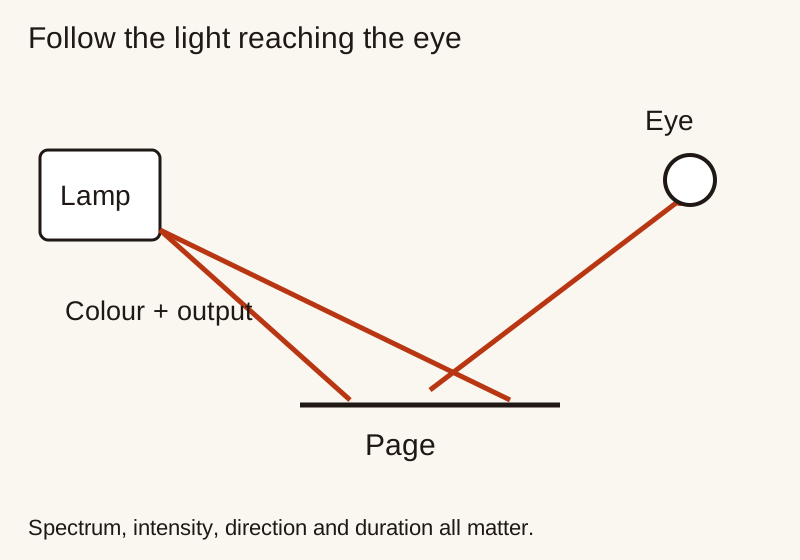
For a buying decision, look for useful dimming and control of spill onto the face or a partner’s pillow. Use enough light to read comfortably and direct it to the page. A lamp that is too bright at its minimum setting may be less suitable than one with fewer modes and a gentler usable range.
Persistent sleep problems or visual discomfort deserve appropriate professional advice. A reading light should support a comfortable routine; it should not be sold as treatment for insomnia or eye disease. Avoid choosing a product solely from promises to preserve melatonin, eliminate strain or guarantee sleep.
Distinguish spectral research from product outcomes
Laboratory work can help explain why the spectrum matters, but the study design determines what the result means. Terán and colleagues’ lamp study measured lamp emissions and calculated photobiological metrics. Its estimates concern the lamps and conditions assessed. A calculated suppression metric cannot be assigned to every amber book light or treated as a clinical sleep result.
Likewise, a claim about blocking a percentage of blue light needs a defined spectral range and measurement method. It is not interchangeable with a colour-temperature value, and it does not specify the total exposure at the eye. When comparing lights, keep the documented control features and physical fit separate from broad health marketing.
The practical choice remains manageable. Compare how the page looks, whether the light source is visible from the reading position, how low the dimmer goes and how easily the reader can change it. Preserve a return window so those observations can happen with the actual books and room.
What PWM flicker means
Pulse-width modulation, or PWM, dims a light by changing the on-time within repeated cycles. Other driver arrangements change current more continuously. The resulting temporal light modulation depends on the whole driver and lamp, including the selected brightness level.
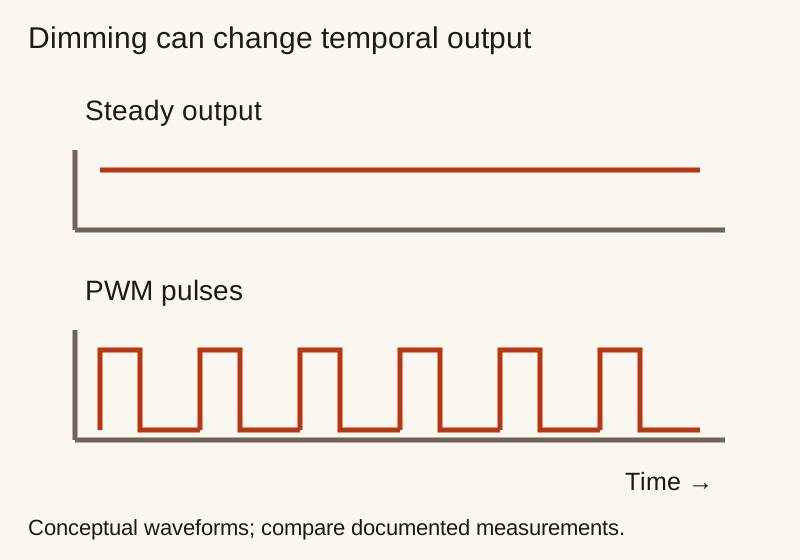
The US Department of Energy’s solid-state lighting guidance on flicker discusses temporal modulation and why visual effects can depend on frequency and waveform. A “flicker-free” label is most useful when supported by a clear test method and settings.
IEEE 1789 is guidance on modulation of high-brightness LEDs. It should not be reduced to a universal promise that one driver type eliminates eyestrain. For a purchase, ask for documented temporal-light measurements across the dimming range if flicker sensitivity is a major concern. Check the exact model rather than assuming all products from the brand share the same driver.
Use a phone camera as a clue, not a certificate
A phone camera may show moving bands when aimed at an illuminated surface. Camera exposure, frame rate, rolling shutter and the lamp waveform all influence that observation. Visible banding can be a reason to investigate the lamp’s dimming behavior further.
A band-free image does not prove constant-current operation or the absence of relevant modulation. Nor can band thickness alone establish a precise PWM frequency. For a sensitive reader, documented measurements and a practical return option are more useful than a claimed ten-second pass/fail test.
Check comfort at the settings the reader will actually use. A lamp that behaves differently at a low setting needs to be evaluated there, rather than only at maximum brightness. If the light produces discomfort, stop using that setup and seek appropriate advice if symptoms persist.
Match the beam to the page
A wider head can help cover a spread, while a small spot may need repositioning after each page turn. Look at the books the recipient reads most often. Large illustrations, glossy pages and dense text can make uneven light or reflections more noticeable than a small paperback does.
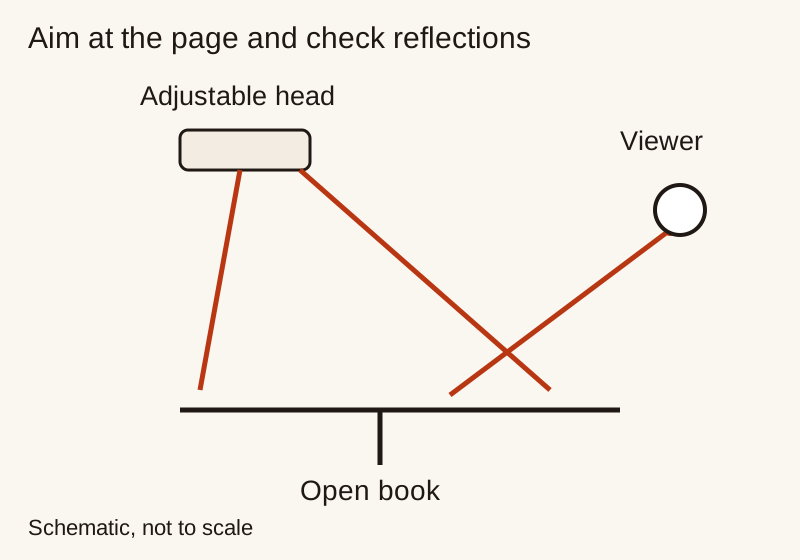
Position the head so that the page is lit without the LED shining directly into the eyes. Adjust angle and height to move a bright reflection off glossy paper. There is no single angle that fits every page finish, lamp beam and viewing position; judge the actual arrangement.
For shared bedrooms, check spill beyond the book. A recessed diffuser or adjustable head may help, but the useful result depends on where the lamp is placed. Ask the partner whether the setup is comfortable rather than assuming amber light is invisible or undisturbing.
Avoid making the lamp’s neck hold a position outside its instructions. A head that slowly droops creates repeated adjustment work. Evaluate the full range needed for the reader’s usual posture, including what happens when they change from sitting upright to reclining.
Check the clip on the actual book
A clamp has to support the lamp without creasing pages, marking a cover or slipping during normal movement. Compare the documented jaw opening and contact surfaces with the intended book. Thin covers and fragile pages need particular care.
The weight figure helps compare candidates, but it does not by itself tell you how the lamp balances. The distance between the clip and light head changes the leverage on the book. A heavier head on a long neck may move differently from a compact head close to the clip.
For delicate books, consider a light attached to a nearby suitable surface or a freestanding lamp. For an e-reader, check bezel clearance and the device maker’s accessory guidance. Avoid pressing a clip onto an active screen or assuming a clamp designed for paper is suitable for every device.
Plan charging and controls for ordinary use
Keep the included cable with the reading setup and check the supported charging source. A USB-C socket describes the connector; the instructions still need to identify the appropriate input and cable arrangement. Test the intended charging combination before giving it as a travel kit.
Compare runtime at the likely setting. The ET-head’s published eight-hour maximum-brightness figure and up-to-80-hour low-setting figure illustrate why a single headline duration is incomplete. Charge indicators and easy access to the port can matter more than an extra colour mode.
For older readers or anyone who prefers simple controls, check the size and location of the buttons. Separate brightness and colour controls can be easier to explain than a sequence of long and short presses. Let the recipient choose whether timer and memory features are helpful.
Questions before wrapping
Is 1800K always blue-free? Colour temperature does not establish an exact spectrum. Compare the maker’s spectral evidence when that property matters, along with dimming and direction.
Does a larger battery always make a better light? It can add reserve, but also weight. Compare the lamp’s support on the book and its runtime at the intended setting.
What makes the gift complete? Include the cable, any required compatible adapter, the control instructions and an exchange receipt. Check that the clip and beam suit the reader’s actual books.
Browse smart home and desk gadgets for related lighting and workspace choices, or use the routine-based gift guide before choosing the lamp format.
Related Gift Buying Guides
Ergonomic Vertical Mouse Guide: Handshake Angle, Forearm Pronation, and Sizing
Choose a vertical mouse by hand size, handedness, button reach and connection needs. Understand the 57-degree shell angle, research findings and a gradual transition.
Read buying guide