USB-C Power Bank: PD Wattage & 100 Wh Limit
A USB-C power bank negotiates fixed PD voltages up to 20V (100W SPR) or 48V (240W EPR) and flies in carry-on up to 100 Wh, or 101-160 Wh with airline approval.
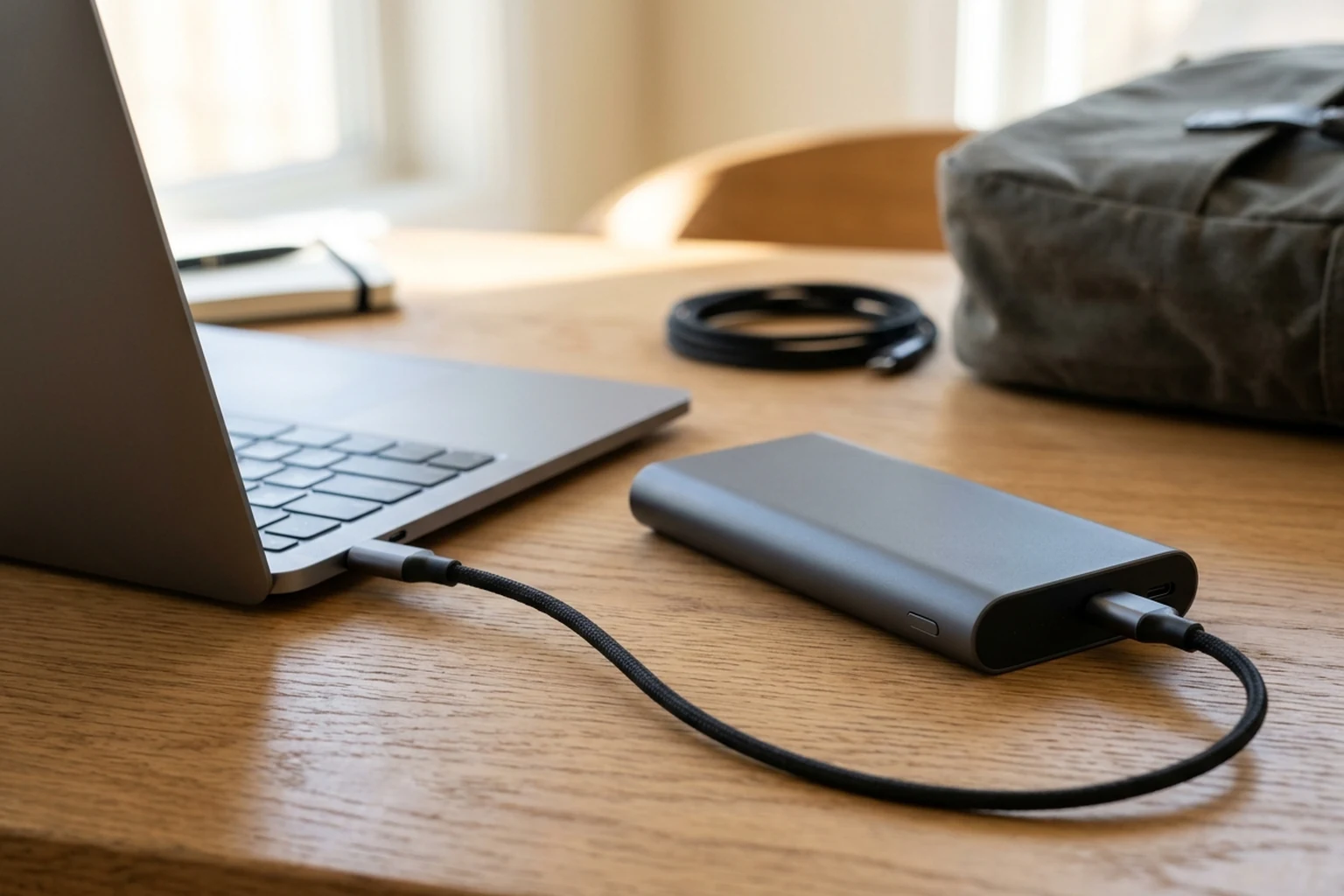
A USB-C power bank delivers its rated charging speed only when the port, the attached cord, and the receiving device agree on the same USB Power Delivery contract: up to 20V and 100W in Standard Power Range (SPR), or up to 48V and 240W in Extended Power Range (EPR) under USB PD Revision 3.1. Even on a high-output port, the USB-IF source-power test rules cap present port power at 60W on a 3A cable and hold an EPR-capable source at 100W or less in SPR mode when the attached cable is not EPR capable. For air travel, 49 CFR 175.10 classifies a power bank as a spare battery that must travel in carry-on baggage only, with passenger rechargeable batteries allowed at 0-100 Wh, restricted to air-carrier approval and at most two spares at 101-160 Wh, and forbidden above 160 Wh on FAA passenger battery guidance.
Buyers comparing portable batteries across different travel and commuting setups can pair these electrical and cabin checks with our tech gift and charging buying guides, which ask gift shoppers to evaluate device compatibility, reserve, and carrying shape before ordering. Once you confirm the required voltage contract and watt-hour band on this page, our everyday power bank gift guide covers pocket fit and daily carry habits while warning buyers not to equate a headline total wattage with single-port output.
Which Fixed Voltages Does a USB-C Power Bank Negotiate?
A laptop or phone charges at full speed from a USB-C power bank only when the port advertises the fixed voltage rail or adjustable voltage range that the device requests. Under USB Power Delivery, power direction is not fixed, so either the host or the peripheral holding energy can supply power while each connected device requests only the power its active workload requires. Every compliant USB PD source must support at least one fixed-supply Power Data Object (PDO) providing vSafe5V so any baseline 5V sink can establish a safe initial contract before requesting higher voltage.
Announced in 2021, the USB PD Revision 3.1 specification expanded USB Type-C power delivery from its earlier 100W ceiling (based on 20V over USB Type-C cables rated at 5A) up to 240W over a full-featured USB Type-C cable and connector. The USB-IF Source Power Requirements Compliance Test Specification (CTS) divides those contracts into two tiers: Standard Power Range (SPR) covers contracts up to 20V and 100W, and Extended Power Range (EPR) covers contracts up to 48V and 240W.
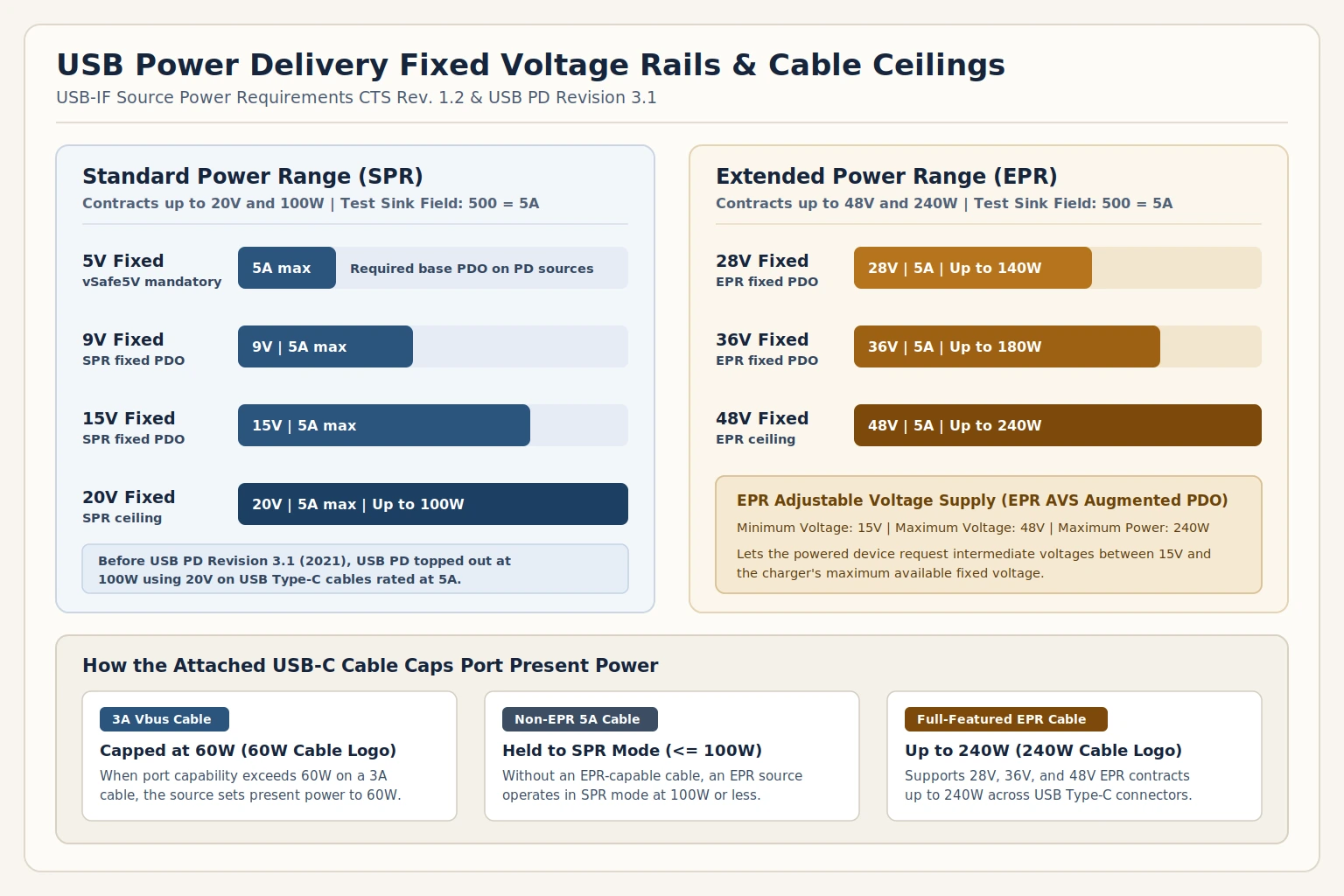
In the USB-IF source-power compliance test, the default SPR sink capabilities message lists four fixed-voltage PDOs at 5V, 9V, 15V, and 20V, each carrying a maximum current field of 500 that the test table labels as 5A. When a source and sink enter EPR mode, the same USB-IF compliance test adds fixed PDOs at 28V, 36V, and 48V, each labeled with a 5A maximum current (field value 500), which USB-IF specifies to enable up to 140W, 180W, and 240W power levels respectively. Alongside those fixed rails, USB PD includes an adjustable voltage supply mode that lets the powered device request intermediate voltages between 15V and the charger’s maximum available fixed voltage; in the USB-IF EPR test table, that Augmented Power Data Object (EPR AVS) spans a 15V minimum voltage to a 48V maximum voltage at up to 240W maximum power.
| USB PD Range and Object | Voltage Specification | Test Sink Current Field | Power Capability Ceiling |
|---|---|---|---|
| Mandatory Base Fixed Supply (vSafe5V) | 5V fixed PDO required on every USB PD source | 500 (5A in SPR test sink) | Part of SPR contracts up to 100W |
| Standard Power Range (SPR Fixed PDOs) | 5V, 9V, 15V, and 20V fixed voltages | 500 (5A per fixed PDO) | Up to 100W at 20V on 5A USB Type-C cables |
| Extended Power Range 28V Rail (EPR Fixed PDO) | 28V fixed voltage | 500 (5A) | Enables up to 140W |
| Extended Power Range 36V Rail (EPR Fixed PDO) | 36V fixed voltage | 500 (5A) | Enables up to 180W |
| Extended Power Range 48V Rail (EPR Fixed PDO) | 48V fixed voltage | 500 (5A) | Enables up to 240W |
| EPR Adjustable Voltage Supply (EPR AVS APDO) | Intermediate voltages from 15V minimum to 48V maximum | Maximum Power 240 (240W) | Up to 240W maximum power |
Checking the exact rail table on a power bank prevents the mismatch where a buyer sees a high combined wattage on the box, plugs in a notebook that expects a 20V or 28V contract, and discovers that the chosen USB-C socket stops at a lower fixed voltage. If your mobile setup also powers an external travel screen over USB-C, check our portable USB-C monitor power and brightness guide to see how display input thresholds interact with USB PD rails. When an AC receptacle is within reach and battery weight is unnecessary, compare a dedicated wall adapter using our guide on how to choose a phone charger as a gift before buying a heavy power delivery charger pack.
How Does a 60W or 240W Cable Cap Port Wattage?
A USB-C cord with a lower current or voltage rating forces a compliant USB PD power bank to step its output down before power reaches the connected device. Under the USB-IF Source Power Requirements CTS, when a port’s present power capability would exceed 60W but the attached cable’s Vbus current-handling capability is 3A, the port must set its present power capability to 60W. Likewise, when a port’s present power capability would exceed 100W on an EPR-capable source and the attached cable is not EPR capable, the source must operate only in SPR mode and set its present power capability to 100W or less.
Electronic cable marking lets a USB-C port verify whether an attached cord supports higher current or voltage contracts. The USB Type-C Connectors and Cable Assemblies Compliance Document states that USB Type-C cable assemblies shall be electronically marked as specified in the current USB Type-C Cable and Connector Specification, while noting that not all cable assemblies require electronic marking. To make power limits readable without a protocol analyzer, the USB-IF compliance program requires every certified USB-C to USB-C cable category to carry a power capability label of either 60W or 240W. In USB-IF’s published compliance example, a USB 20Gbps USB-C to USB-C cable that supports 20V at 3A must carry the Combined Performance and Power 20Gbps/60W logo.
Independent safety testing programs draw separate electrical boundaries for cords that carry both data and DC charging current. UL Solutions runs an ICT power-cable certification program covering cable assemblies that deliver data transmission and power in a circuit not exceeding 60 volts DC, 8.0 amperes, and 100 watts. Do not confuse those 60V DC and 8.0A UL component-test boundaries with negotiated USB Power Delivery profiles, which follow the USB-IF 5V through 48V PDO rails and 3A or 5A cable rules above. For physical cord length, jacket durability, and connector fit alongside a travel battery, see our guide on how to choose a USB-C cable as a gift.
Why Does Plugging In a Second Device Cut Laptop Power?
Plugging a phone or earbuds case into a second port on a multi-port USB-C power bank can reduce the wattage available to a connected laptop because shared-capacity ports divide a finite internal power gang. Rather than locking ports to a rigid split regardless of load, USB Power Delivery lets each device take only the power it requires and request additional power when an application demands it. Under the USB Type-C Shared Capacity Charger Interoperability CTS, the power contract on an active port may change whenever another device plugs into an adjacent port, depending on how much power the newly attached device requires and how it requests that power.
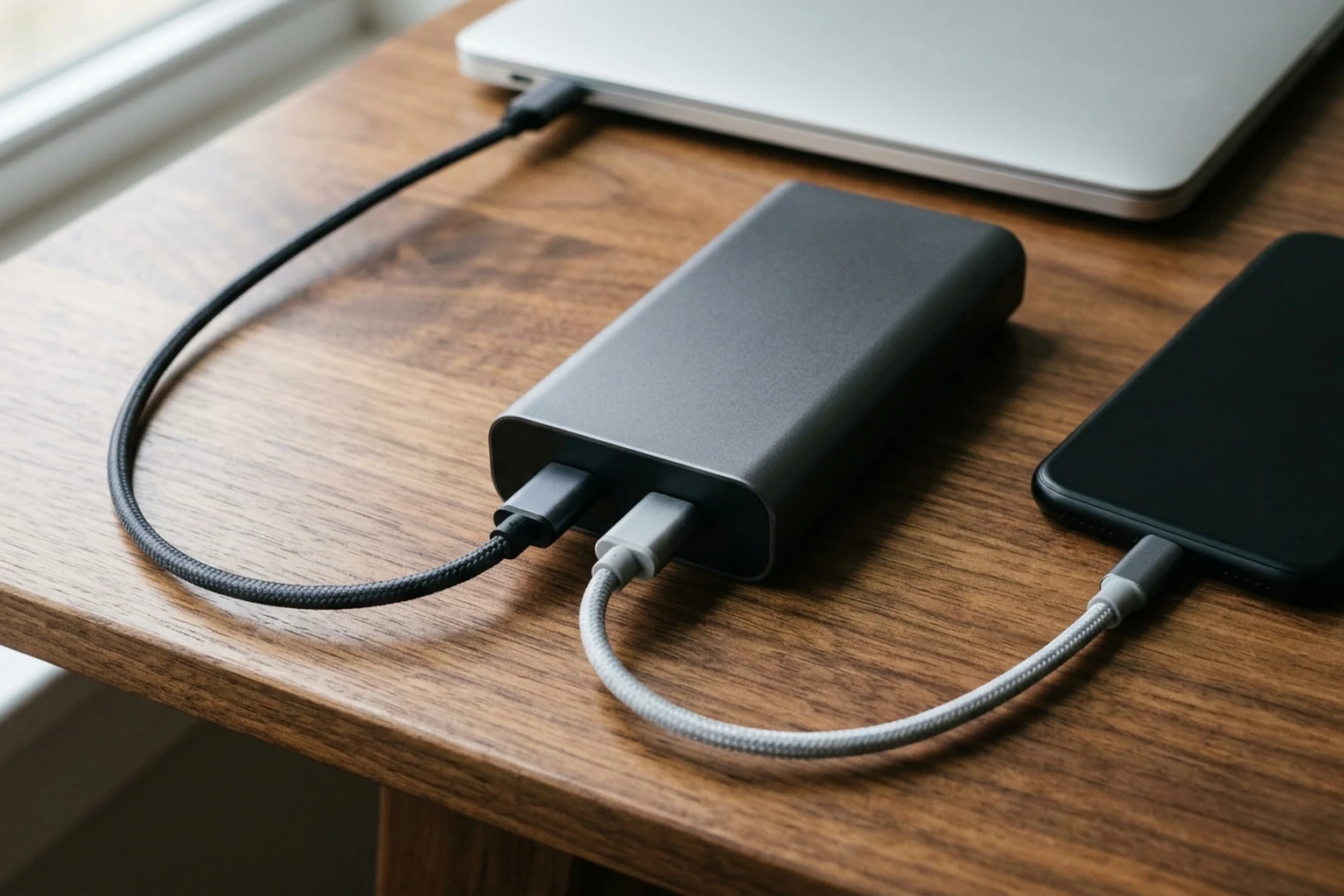
To pass the USB-IF shared-capacity interoperability specification, a multi-port charger’s shared power gang must meet five behavioral conditions whenever loads change across its sockets. First, the power gang must not advertise more than the available gang power across its ports. Second, each port must advertise at least 7.5W while the charger remains powered. Third, the charger must notify all ports whenever the shared power reserve changes. Fourth, all port power contracts must settle within 3s after a power-reserve change. Fifth, the charger must complete port power rebalancing without using a Hard Reset, Error Recovery, or Disabled state.
Those five USB-IF rules keep the contracts inside the shared gang: they settle within 3s after a power-reserve change, and rebalancing finishes without a Hard Reset, Error Recovery, or Disabled state. Because the power contract on one port may change when a device is plugged into another port, read the manufacturer’s simultaneous-output table for two-port combinations rather than the single-port headline number. If you plan to recharge the power bank from a wall adapter while powering devices at the same time, verify the bank’s rated USB-C input wattage as well, or compare stationary multi-device docks and cable organizers in our smart home and desk gadgets hub.
How Do You Convert mAh Labels to Airline Watt-Hours?
Battery labels and specification sheets can list capacity in milliamp-hours (mAh), whereas aviation hazardous-materials regulations set passenger limits in watt-hours (Wh). Under federal hazardous-materials definitions in 49 CFR 171.8, a watt-hour is a unit of energy equivalent to 1 watt (1 W) of work acting for 1 hour (1 h) of time, and the watt-hour rating of a lithium-ion cell or battery equals its rated ampere-hour capacity multiplied by its nominal voltage: Wh = Ah × V.
Beginning May 10, 2024, 49 CFR 173.185 requires each lithium-ion battery to be marked with its watt-hour rating directly on the outside case. When you inspect an older battery or a specification sheet where the watt-hour figure is not printed, use the conversion formula published in the FAA passenger battery guide: multiply volts (V) by amp-hours (Ah), or if capacity is printed in milliamp-hours (mAh), divide mAh by 1000 to convert to Ah and then multiply by the nominal voltage (V). In the FAA’s worked example, a 12-volt battery rated at 8 Ah equals 96 Wh (12 x 8 = 96), placing it inside the 0-100 Wh passenger allowance. Multiply that amp-hour capacity by the nominal battery voltage specified for the cell or battery pack rather than substituting the USB-C port’s negotiated 5V, 9V, 15V, or 20V output rails.
What Are the FAA and TSA Rules for Power Banks?
Federal aviation and screening rules treat every portable power bank as an uninstalled spare lithium battery rather than a regular electronic device. Under 49 CFR 175.10, any article containing lithium-metal or lithium-ion cells or batteries whose primary purpose is to provide power to another device must be carried as a spare battery in carry-on baggage only. FAA PackSafe lithium battery rules require spare lithium batteries, including power banks and cell phone battery charging cases, in carry-on baggage only. TSA power bank screening rules prohibit power banks and portable chargers in checked bags. Under FAA PackSafe, when a carry-on bag is checked at the gate or at planeside, all spare lithium batteries and power banks must be removed from the bag and kept with the passenger in the aircraft cabin. By contrast, a laptop or phone containing an installed rechargeable lithium battery can be placed in checked baggage only if it is completely switched off (not in sleep or hibernation mode), protected against unintentional activation or damage, and within the watt-hour limits.
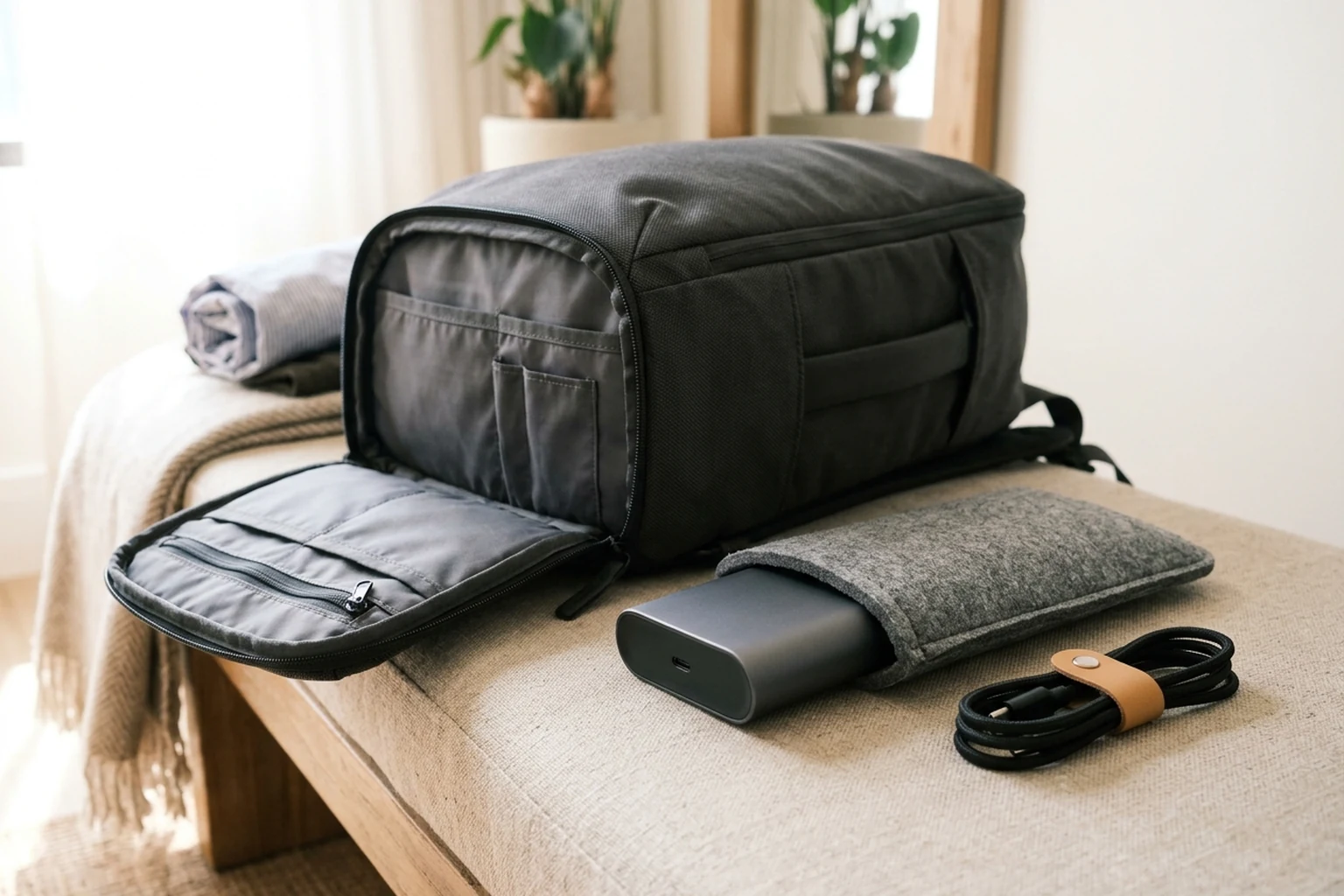
Passenger watt-hour and quantity rules split lithium-ion power banks into three clear regulatory bands across 49 CFR 175.10 and FAA guidance. In the standard band (0-100 Wh, written in 49 CFR 175.10 as not exceeding 100 Wh), lithium-ion power banks are allowed in carry-on baggage with no federal quantity cap provided the batteries are for the passenger’s personal use; batteries carried for further sale or distribution, such as vendor samples, are prohibited. In the medium band (written in 49 CFR 175.10 as exceeding 100 Wh but not exceeding 160 Wh, and in FAA passenger tables as 101-160 Wh or exceeding 101–160 Wh), air-carrier approval is required and each passenger may carry no more than two individually protected spare lithium-ion batteries. Above 160 Wh, lithium-ion batteries are forbidden on passenger aircraft, a ban that FAA explicitly applies to stand-alone generators, back-up generators, and batteries that form part of a solar power system.
| Battery Rating Band | Cabin vs Checked Baggage | Passenger Quantity and Approval Rule | Mandatory Safety and Case Conditions |
|---|---|---|---|
| 0-100 Wh (not exceeding 100 Wh) | Carry-on baggage only; prohibited in checked bags and gate-checked bags | Allowed without carrier approval; no federal count limit for personal passenger use (sale or distribution prohibited) | UN Manual of Tests and Criteria Sub-section 38.3 tested type; outside-case Wh mark (from May 10, 2024); individual short-circuit protection |
| Exceeding 100 Wh up to 160 Wh (FAA 101-160 Wh band) | Carry-on baggage only; prohibited in checked bags | Requires aircraft operator approval; no more than two spare lithium-ion batteries per person | UN Manual of Tests and Criteria Sub-section 38.3 tested type; outside-case Wh mark; individual short-circuit protection |
| Exceeding 160 Wh (including stand-alone and solar generators) | Forbidden on passenger aircraft in both cabin and checked baggage | Forbidden for passenger air transport | Exceeds the 160 Wh lithium battery limit |
Physical condition and manufacturing test standards apply regardless of watt-hour size. Under 49 CFR 175.10, each installed or spare lithium battery carried by a passenger must belong to a design type proven to meet every test in the UN Manual of Tests and Criteria, Part III, Sub-section 38.3, and each spare battery must be individually protected to prevent short circuits by keeping it in original retail packaging, taping over exposed terminals, or placing each battery in a separate plastic bag or protective pouch. FAA rules also bar damaged or recalled batteries and battery-powered devices likely to create sparks or generate a dangerous evolution of heat from both carry-on and checked baggage unless the damaged or recalled battery has been removed or made safe. Beyond federal transport rules, shoppers can look for UL 2056 testing, which UL Solutions offers specifically to evaluate the safety of portable power banks, and should check their operating airline before departure because FAA notes that many domestic and international airlines may have stricter watt-hour and quantity limits.
Sources
- FAA PackSafe: Lithium Batteries
- FAA PackSafe: Airline Passengers and Batteries
- TSA What Can I Bring: Power Banks
- eCFR: 49 CFR 175.10 Exceptions for Passengers, Crewmembers, and Air Operators
- eCFR: 49 CFR 173.185 Lithium Cells and Batteries
- eCFR: 49 CFR 171.8 Definitions and Abbreviations (Watt-hour)
- USB Implementers Forum (USB-IF): USB Charger (USB Power Delivery Revision 3.1 overview)
- USB Implementers Forum (USB-IF): Cable and Connector Compliance Program (60W and 240W cable power markings)
- USB Implementers Forum (USB-IF): USB-C Source Power Requirements Compliance Test Specification
- USB Implementers Forum (USB-IF): USB Type-C Shared Capacity Charger Interoperability Compliance Test Specification
- USB Implementers Forum (USB-IF): USB Type-C Connectors and Cable Assemblies Compliance Document
- UL Solutions: Battery and Power Bank Safety Testing (UL 2056 and ICT Power Cable Certification Program)
Related Gift Buying Guides
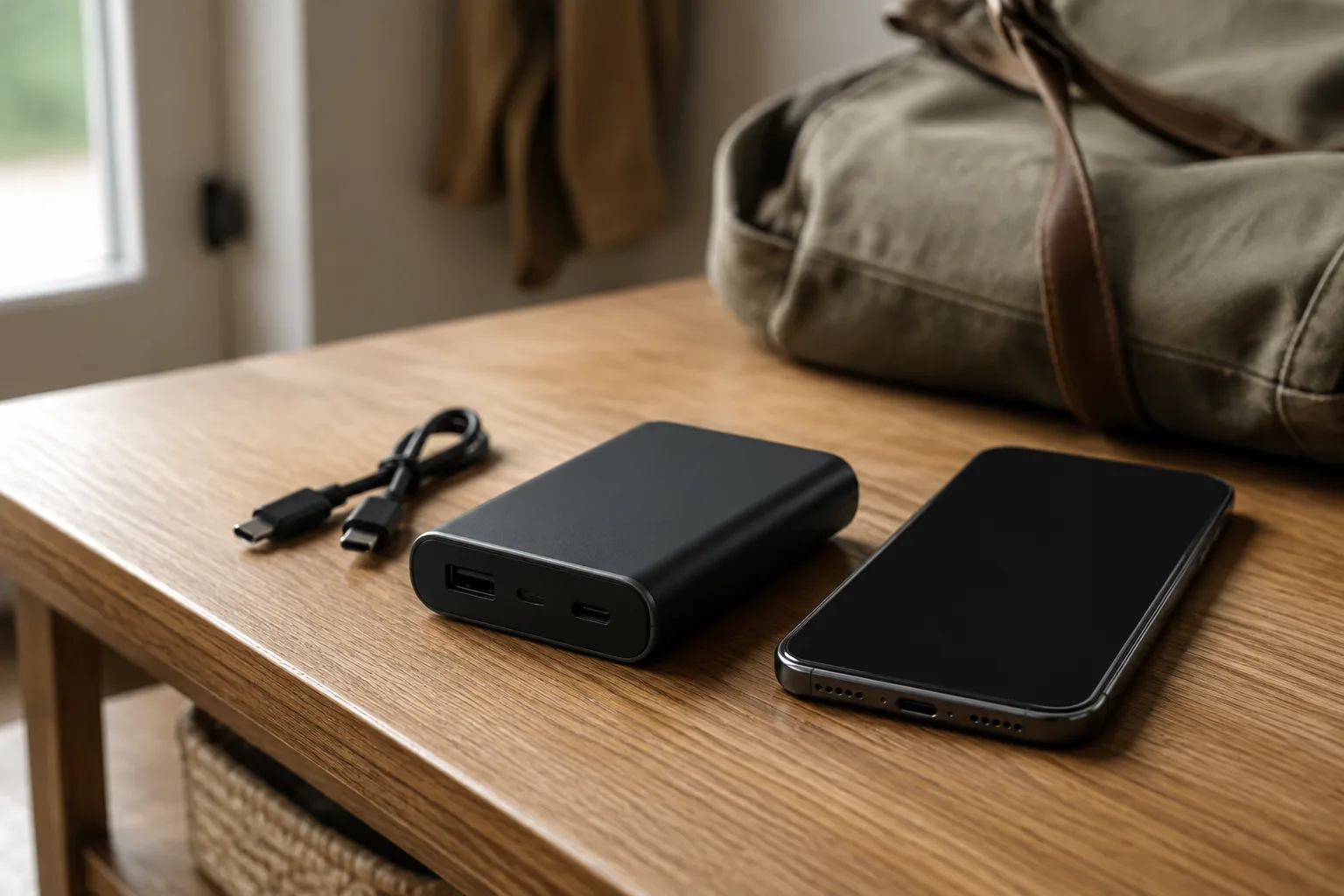
How to Choose a Power Bank as a Gift
Choose a power bank for the recipient’s devices, daily charging needs, carrying space and travel requirements.
Read buying guide
How to Choose a Phone Charger as a Useful Gift
Choose a phone charger by device requirements, supported charging profiles, shared port output, cable compatibility and safe placement.
Read buying guide
How to Choose a Phone Stand as a Useful Gift
Choose a desk phone stand by phone and case fit, viewing position, stability, cable access and storage space.
Read buying guide